



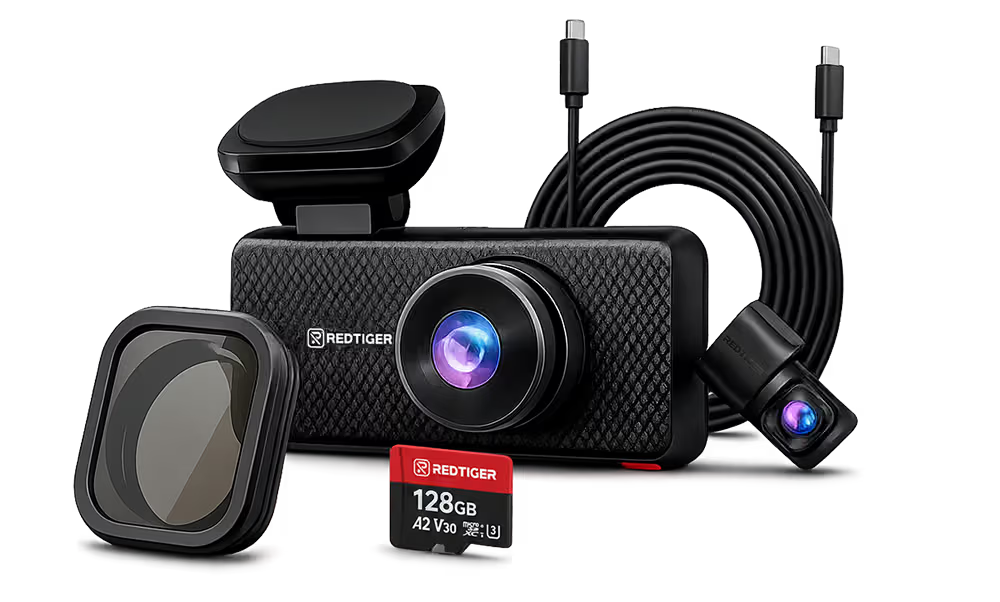


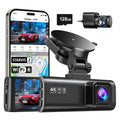

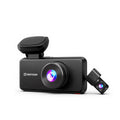
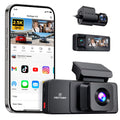

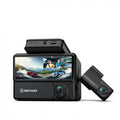















A dual 4K dash cam records the road ahead and the road behind you in true 4K detail. Most front-and-rear systems pair a sharp front camera with a softer 1080P rear camera. A 4K dual dash cam closes that gap, keeping license plates readable.
If you are going for a dual 4K dash cam, you probably want proof you can trust. You want clear plates at night, a rear view that holds up after a crash, and protection while you park.
This guide covers sensors, HDR, night recording, storage, connectivity, and parking monitoring. We also use the REDTIGER F77 as a real example. It's a dual 4K dash cam built around two Sony IMX678 sensors that gets the job done perfectly.
What Is a Dual 4K Dash Cam?
A dual 4K dash cam is a two-camera system that records the front and rear views at 3840×2160 resolution. Many "dual-channel" dash cams record 4K in the front and only 1080P in the rear.
The real question is whether each camera captures true 4K data (REDTIGER). With that definition in place, here is how a dual 4K dash cam works.
How Front and Rear 4K Recording Works
One the dual channel dash cam mounts on the windshield. The second mounts inside the rear window and connects by cable. Both record at once, and you can show both views on screen.
Each camera has its own image sensor. In a dual 4K dash cam, both sensors must handle 4K. The Sony IMX678 does, with about 8.29 million recommended recording pixels arranged 3840 by 2160.
The 4K dual dash cam F77 uses one IMX678 per camera. Its rear camera is not waterproof, so mount it inside the car.
Native 4K vs. Upscaled 4K
Not every dual 4K dash cam delivers the same 4K. Native 4K means the sensor captures 3840×2160 pixels. Upscaled 4K means the sensor captures fewer pixels, and software enlarges the image to fill a 4K file.
You notice the difference when you zoom in on a license plate. Native footage from a dual 4K dash cam keeps the fine detail the sensor actually captured.
Meanwhile, upscaled footage looks noticeably soft. REDTIGER has several budget-friendly models labeled as upscaled 4K. So, check them before you buy. Start with the sensor's IMX number on the specification sheet.
Dual 4K vs. 4K Front and 1080P Rear Dash Cams
Most dual dash cams pair a premium front sensor with a 1080P rear camera. It's a deliberate trade-off, since the front camera does most of the evidence-gathering. Still, a dual 4K dash cam raises the bar.
A dual 4K dash cam makes sense when the rear view matters just as much as it does for rideshare drivers and highway commuters. The trade-offs for a 4K dual dash cam are a higher price and larger files.
Why Choose a 4K Dual Dash Cam for Front and Rear Protection?
A 4K dual dash cam protects you from both directions. The front camera shows what you did and saw.
The rear camera shows what happened behind you. Together, the footage gives insurers and police a fuller story.
Capture More Detail in Front-Facing Footage
4K packs more pixels into every frame. REDTIGER F77 records 8.3 million pixels per frame, about four times the detail of 1080P. That helps when you need to zoom in on plates and road signs.

Night footage matters even more. NHTSA counted 6,736 rural and 13,573 urban traffic deaths in dark conditions in 2023. A dual 4K dash cam that sees clearly after sunset is not a luxury. It is the point.
Record Rear-End Collisions and Hit-and-Run Incidents
Rear-end crashes are common, and fault is often disputed. A NHTSA-sponsored analysis found that inattention and following too closely are the main causes. A DOT analysis found that rear-end crashes account for about 23 percent of police-reported crashes.
Safety tech helps. IIHS found that forward collision warning with autobrake cut rear-end crashes by 39 percent. But those systems help the car that hits. They don't record evidence when someone hits you.
Hit-and-run crashes add another risk. The AAA reports that 15 percent of reported crashes involved a driver who fled. Fatal crashes often happen late at night, when it is dark, and witnesses are scarce. A rear 4K camera can catch a plate nobody else saw.
Preserve Useful Evidence in Everyday Driving
Most dual 4K dash cam footage isn't about disasters. It settles small arguments: who merged first, who ran the light, or who dented your door in the lot. GPS logging adds location and speed.
One tip for claims: save the original file from the storage card. Don't send a compressed copy re-uploaded through a chat app. Let's see which dual 4K dash cam features matter.
What Features Matter Most in a Dual 4K Dash Cam?
Five features matter most in a dual 4K dash cam –
-
The image sensor
-
HDR
-
Resolution with compression
-
GPS with loop recording
-
Storage
Resolution alone does not guarantee good footage. The sensor decides whether pixels hold real detail or just noise. Let's begin with the part that does the seeing.
Image Sensors for Day and Night Recording
Sony introduced STARVIS 2 as a low-light sensor family for surveillance and automotive cameras. Three traits matter: pixel size, back-illumination, and dynamic range.
Larger pixels collect more light, and back-illuminated designs let more light reach the chip.
The IMX678 is a 1/1.8-inch sensor with 2.0 µm pixels. It is a common pick for a dual 4K dash cam. Look for the IMX number, not just the words "Sony STARVIS 2."
Front and Rear HDR for Challenging Lighting
HDR helps a camera keep both bright and dark areas readable in one frame. That matters at tunnel exits and when oncoming high beams hit your lens. Sony lists an HDR function for the IMX678.
Check whether HDR covers both cameras of the 4K dual dash cam you want. REDTIGER's comparison table shows some models with front-only HDR, while the F77 lists front and rear HDR.
Resolution, Frame Rate, and Video Compression
Sensor limits and camera settings are different things. The IMX678 can run up to 60 frames per second, but a dash cam may record at a lower rate. Check the recording specs, not just the sensor name.
A dual 4K dash cam also creates bigger files: 10 to 12 GB per hour for 4K front plus 1080P rear. Dual 4K uses more storage, so plan accordingly. These tools keep all that footage organized.
GPS, Loop Recording, and Video Management
GPS records where and how fast you were driving. Loop recording overwrites the oldest clips when storage fills up.
A G-sensor locks footage on impact, so a crash clip survives. REDTIGER also offers a mobile app plus a desktop player — note that the desktop player is for Windows and Mac only, so Android and iOS users should work from the app.
Storage Capacity and File Backup
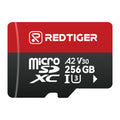
Dual 4K dash cams offer two storage options. Many models use removable microSD cards. The F77 uses built-in eMMC 5.1 storage in 128GB or 256GB, and its microSD slot is a backup path rather than a recording target — you copy clips you want to keep onto the card, and the card itself does not record on its own. The F77 supports cards up to 512GB.
The F77 uses built-in eMMC 5.1 storage rated by REDTIGER at sequential reads up to 240MB/s and writes up to 160MB/s — roughly an order of magnitude faster than a typical microSD card. These are manufacturer figures, not lab results.
With that in mind, let's see how one dual 4K dash cam measures up.
REDTIGER F77: A Dual 4K Dash Cam with Dual Sony IMX678 Sensors
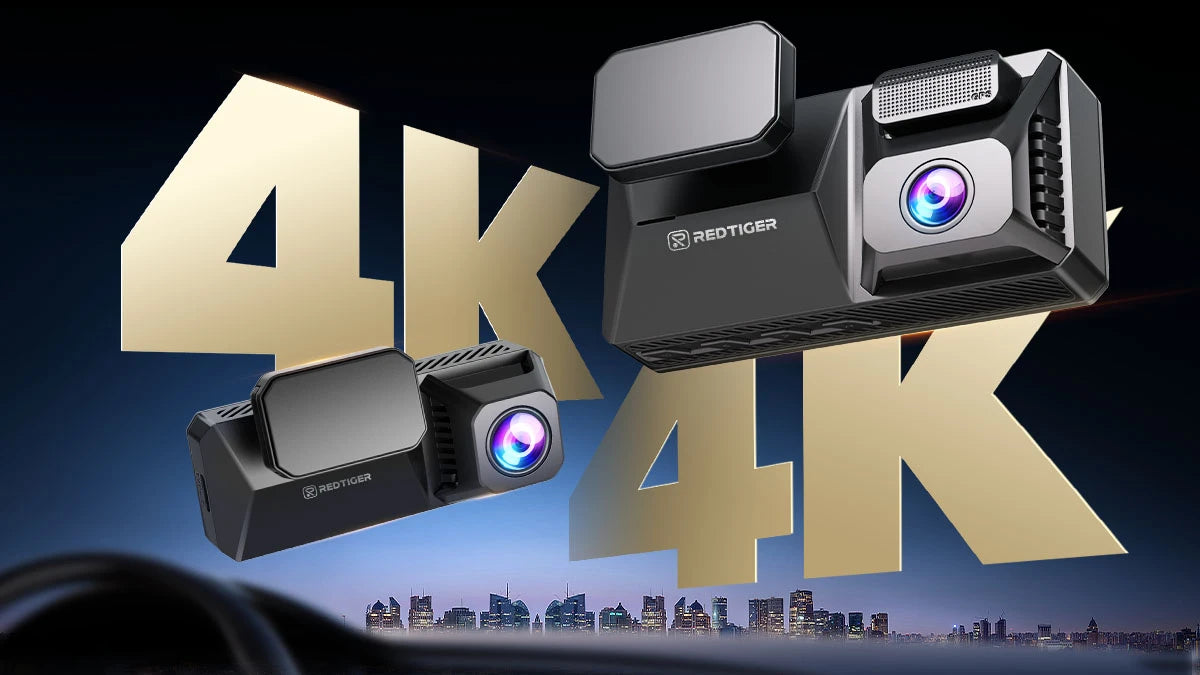
The REDTIGER F77 records native 4K from both cameras using two Sony IMX678 sensors. It adds front and rear HDR, built-in eMMC storage, a 4-inch touchscreen, voice control, GPS, and 5.8GHz Wi-Fi. It's the first dash cam with 4K on both channels.
4K Recording from Both Front and Rear Cameras
As a dual 4K dash cam, the F77 records both cameras at once and shows both on its screen. Each lens has an F1.8 aperture.
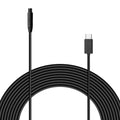
Installation has one quirk. The F77's rear cable doesn't work with REDTIGER's F7N-series rear cameras. Owners of larger vehicles can add a 33-foot replacement cable.
Sony IMX678 Sensors and HDR Technology
The dual 4K dash cam pairs two IMX678 STARVIS 2 sensors with HDR on the front and rear. It tames headlight glare and lifts detail from dark shadows.
A few buyers mention windshield reflections on the official product page. Still, the dash cam holds a magnificent 4.8 rating (out of 5.0) from ~200 reviews.
The F77 pairs two Sony STARVIS 2 IMX678 sensors front and rear. STARVIS 2 is Sony's second-generation low-light sensor family, so the night gain comes from the sensor generation itself rather than from a marketing percentage. Compare night samples yourself before you commit.
5.8GHz Wi-Fi, App Connectivity, and Voice Control
The F77 dual 4K dash cam uses 5.8GHz Wi-Fi to link with the REDTIGER app for viewing and sharing clips. Its 8Mb/s speed falls short of the 20Mb/s listed for the F7NA.
You must manually join the camera's Wi-Fi network. Voice control covers 12 commands, such as locking a video or taking a photo. A 4-inch touchscreen handles everything else.
GPS, Built-In Storage, and Parking Monitoring
The 4K dual dash cam includes GPS, a G-sensor, and loop recording. Built-in storage means no card to buy, manage, or maintain.
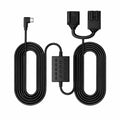
Parking monitoring needs the hardwire kit. REDTIGER includes one proprietary kit that handles the job with minimal hassle.
Parking modes come in two kinds. Collision detection wakes the camera on impact but can miss slow scrapes. Time-lapse records at a low frame rate.
The F77 uses a supercapacitor and works from -20°C to 70°C. A parked car can reach 140°F, which can degrade lithium batteries.
Who Should Consider the REDTIGER F77?
The F77 suits drivers who want the strongest dual 4K dash cam evidence from both directions. REDTIGER targets tech fans, professional drivers, and luxury-vehicle owners. Rideshare and frequent highway drivers are natural fits too.

In October 2026, redtigercam.com lists the 128GB F77 at $199.99 and the 256GB model at $229.99. Promo pricing moves, so check the product page for the live price before you buy.
The warranty is 18 months, plus 6 more on official orders.
You might skip this dual 4K dash cam if you mostly drive in daylight on a budget. REDTIGER suggests the F7NA then, with native 4K in front and 1080P in back. Let's put it all together to help you make a definitive purchase decision.
How to Choose the Right 4K Dual Dash Cam for Your Car
Start with how you drive, then check four things: camera placement, storage, parking-mode wiring, and software with warranty. A 4K dual dash cam is only as good as its install and power setup.
Check Camera Placement and Rear-Window Compatibility
Measure before you buy any 4K dual dash cam. The rear camera sits inside the car and connects by cable, so SUVs, vans, and trucks may need a longer one. The F77 offers a 33-foot option.
Check your state's rules on windshield mounting. Place the front camera near the rearview mirror so it can't block your view. After placement, think about where your dual 4K dash cam saves footage.
Compare Storage Options and Recording Settings
Decide between built-in storage and removable cards for your dual 4K dash cam. Built-in eMMC means no card. For long trips or heavy parking-mode use, pick the larger size.
Understand Hardwiring and Parking Mode Requirements
Every parking mode on a dual 4K dash cam needs a hardwire kit. Your car's accessory port shuts off with the ignition, so the kit taps a fused circuit and adds a low-voltage cutoff to protect your battery.
The F77 will not run parking monitoring without it. The camera's Wi-Fi doesn't drain your battery because the radio turns on only when you connect the app. If fuse-box work feels risky, ask a shop to install it.
Review App Compatibility, Warranty, and Included Accessories
Confirm the app works with your phone and that firmware updates are available. Check the warranty and return window too.
REDTIGER offers 30 days for returns and up to 24 months of warranty on official orders. The F77 also ships with its hardwire kit.
Conclusion
A dual 4K dash cam gives you sharper plates, a clearer rear view, and better night footage than most front-and-rear systems. When choosing a 4K dual dash cam, look for true native 4K, good sensors on both cameras, HDR, enough storage, and a proper hardwire setup.
REDTIGER F77 holds everything in one package. Drive without worrying about any incident that may require your recording obligations. Still, it captures everything clearly so that you can enjoy great memories. Visit the product page for current pricing based on storage.
Frequently Asked Questions (FAQs)

Leave a comment
All comments are moderated before being published.
This site is protected by hCaptcha and the hCaptcha Privacy Policy and Terms of Service apply.