



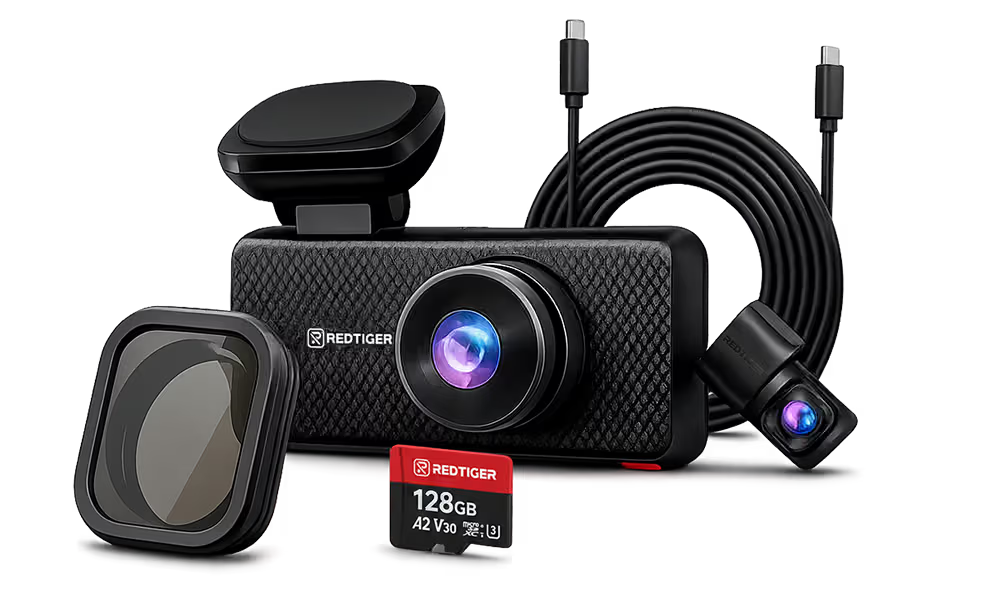



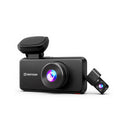
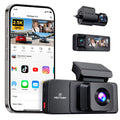

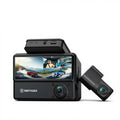















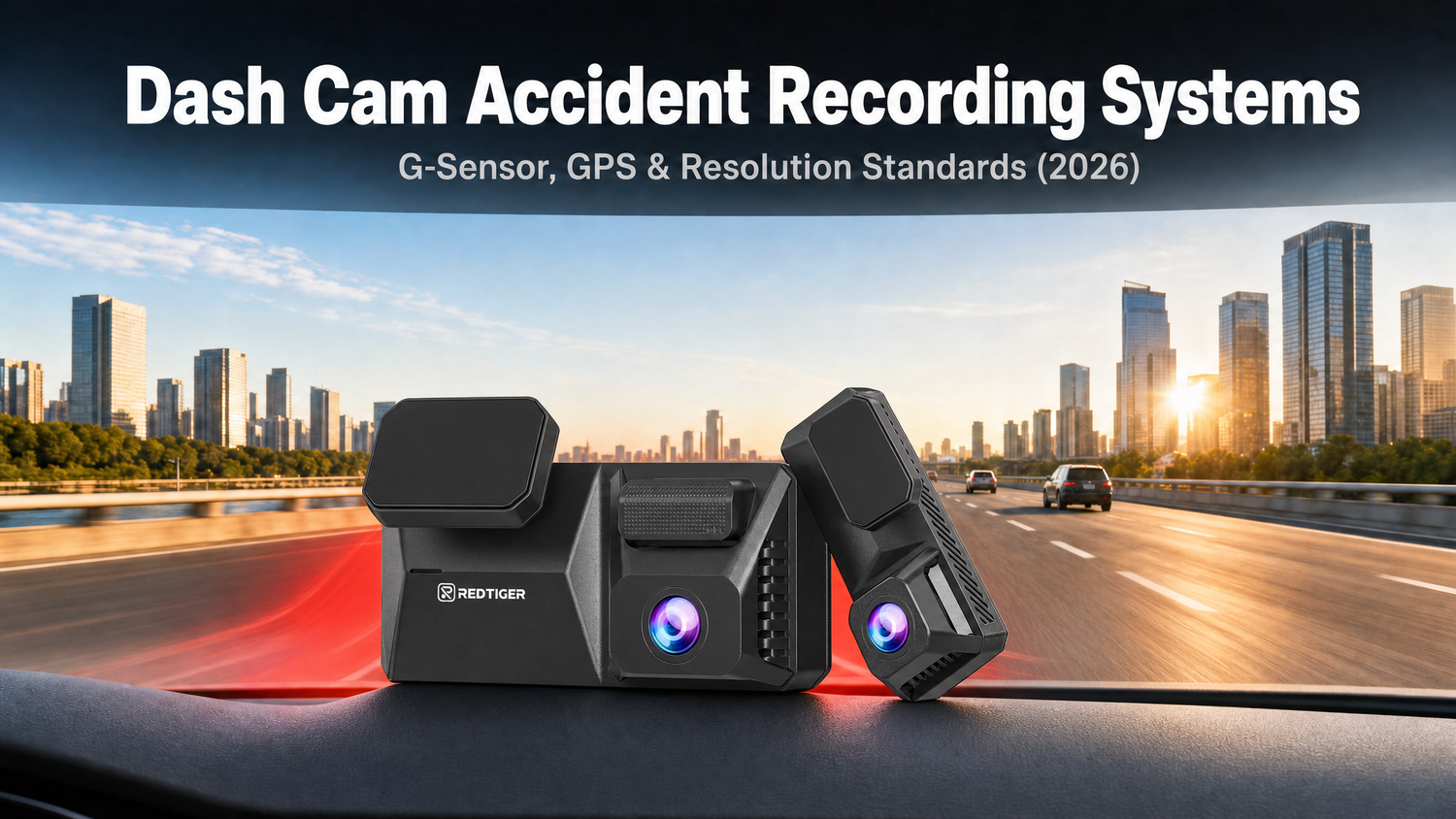
Quick answer: A reliable accident recording system requires four hardware capabilities working together: native 4K resolution (not upscaled), a calibrated g-sensor that locks footage before loop recording can overwrite it, GPS timestamp embedding on every clip, and storage that survives continuous duty cycles. This guide explains each standard and which REDTIGER cameras meet all four.
Why Footage Quality Determines Whether a Claim Is Resolved
Insurance adjusters and attorneys do not review footage to find the "best" clip — they need footage that establishes specific facts: the license plate of the other vehicle, the speed at the moment of impact, the exact timestamp, and the state of traffic conditions in both directions.
Footage that cannot establish those facts is not useless, but it is inconclusive. Inconclusive footage produces he-said-she-said outcomes, which default to proportional fault or contested liability. The purpose of an accident recording system is to produce footage that is conclusive — that ends the dispute rather than extending it.
The hardware determines the outcome, not the recording itself.
Resolution Standard: Native 4K vs Upscaled 4K
The most commonly cited spec for accident documentation is 4K resolution. The distinction that matters — and that most camera listings do not specify — is whether the 4K is native or upscaled.
Native 4K (3840×2160): The image sensor physically captures 8 megapixels per frame. Every pixel in the output corresponds to actual light data from the scene.
Upscaled 4K: A lower-resolution sensor (2K, 2.5K) captures the image, and the processor scales the output to fill a 4K file. The file size is 4K. The actual detail is not.
The practical consequence is license plate legibility. At 40–50 feet — a typical following distance at an urban intersection — a standard 7-character US license plate spans approximately 22–24 pixels across in native 4K footage. That is enough to read every character clearly under normal daylight conditions. In upscaled output from a 2K sensor, the same plate spans approximately 12–14 pixels. Characters become ambiguous under compression, particularly at night.
The REDTIGER F77 and F7NA both use the Sony IMX678 STARVIS 2 image sensor — an 8MP BSI CMOS that captures natively at 3840×2160. The 4K output in both cameras is not a processing artifact. Every frame contains full-resolution data.

G-Sensor: How Emergency Clip Locking Works
Loop recording is the standard operating mode for any dash cam: new clips overwrite the oldest on a continuous cycle. This is correct behavior during normal operation. The problem is that loop recording cannot distinguish between a routine commute and an incident — without intervention, collision footage is overwritten like any other clip.
The g-sensor solves this. It measures acceleration and deceleration force across three axes (X, Y, Z). When the force reading crosses a threshold — detecting the rapid deceleration of a frontal impact or the lateral force of a side collision — the g-sensor triggers emergency clip locking.
What happens at trigger:
- The current clip is immediately moved to a protected event folder
- The clip recorded immediately before the trigger (capturing the lead-up to impact) is also locked
- Loop recording cannot overwrite clips in the protected folder
The result is a continuous protected record covering the seconds before, during, and after the collision. Protected clips survive all subsequent recording sessions until the user manually deletes them.
G-sensor calibration matters. Set too low, the sensor triggers on speed bumps and sharp turns — the protected folder fills with irrelevant clips and available storage shrinks. Set too high, it misses low-speed impacts. The F77 and F7NA both offer adjustable g-sensor sensitivity (Low / Medium / High) configurable through the camera menu. For standard urban driving conditions, Medium is the correct setting. For commercial vehicles on rough roads or job sites, Low sensitivity reduces false triggers.

GPS Timestamp: What Gets Embedded in Every Clip
GPS provides three data points critical to accident documentation: location, speed, and timestamp.
Location: Latitude and longitude from GPS satellites, embedded in the clip as NMEA metadata. If the other party disputes where the collision occurred, GPS coordinates from the footage are the objective record — not a driver's recollection of the intersection.
Speed: Vehicle speed at the moment of impact, derived from GPS Doppler shift — the change in signal frequency as the vehicle moves. This measurement is independent of the speedometer and is embedded in clip metadata rather than overlaid on screen, making it harder to dispute as a display error.
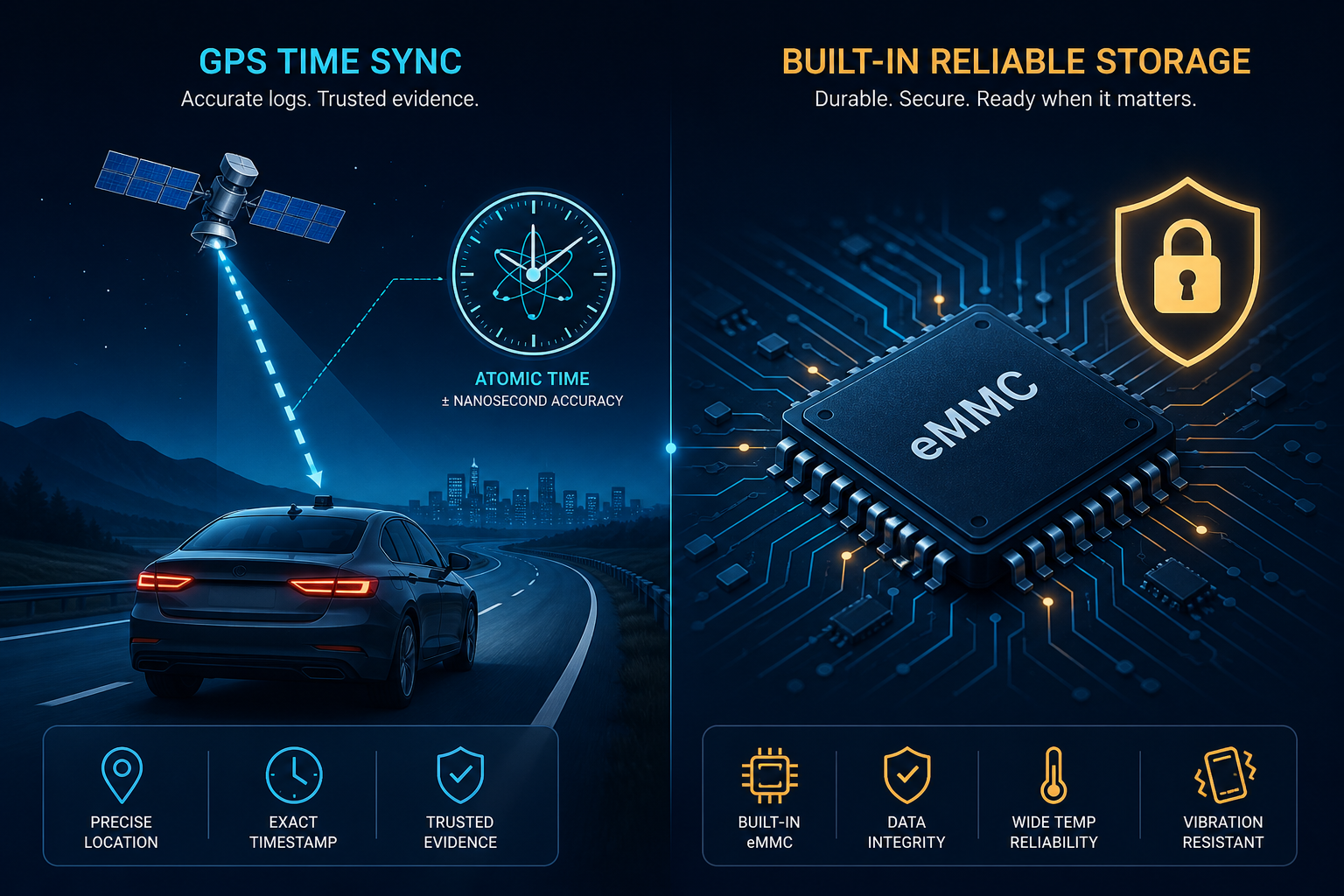
Timestamp: GPS receivers synchronize their internal clock to GPS satellite time, accurate to within 1 second of universal atomic time. The timestamp on every clip is GPS-synchronized — not derived from the camera's internal clock, which drifts over weeks. For insurance claims filed days after an incident, or legal proceedings where timestamp accuracy is contested, GPS-synchronized time is fundamentally more credible than a camera-generated timestamp.
All three data points are embedded in every clip produced by the F77 and F7NA, and rendered on-screen as an overlay for immediate field review.
Storage Architecture: SD Card vs eMMC
The default storage format for a dash cam is an SD card: a removable medium that loop-records until full, then overwrites from the oldest clip forward. SD cards work. They also have one failure mode specific to continuous-recording applications: write cycle degradation.
Loop recording in a vehicle performs thousands of write operations per day at temperatures that fluctuate from freezing to 150°F+ inside a parked car in summer. Consumer-grade SD cards are not rated for this duty cycle. A card that functions correctly for six months may begin producing corrupted clips in months seven through twelve — during recording sessions statistically more likely to contain the footage you need.
The REDTIGER F77 uses built-in eMMC storage: 128GB or 256GB of eMMC 5.1 flash memory physically soldered to the circuit board. eMMC uses wear-leveling algorithms designed for high-duty-cycle embedded applications. The F77 ships with a free hardwire kit for parking-mode continuous recording, and REDTIGER covers it with an 18+6-month warranty. Because the storage is internal:
- No card to unseat during vibration or vehicle impact
- No slot failure from repeated insertion
- Storage cannot be accidentally removed, lost, or stolen from the vehicle
- No card replacement budget over the camera's lifespan
For commercial vehicles and fleet operators where accident recording continuity is a liability requirement, eMMC eliminates the most common hardware failure point in SD-based systems.
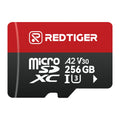
The F7NA uses a standard SD card slot, compatible with high-endurance UHS-I rated cards designed for continuous write cycles.
Dual-Channel Coverage: Why Front-Only Misses the Critical Scenarios
A front-only camera documents what happens ahead of the vehicle. The limitation appears in the disputes most commonly contested by insurance adjusters:
- Rear-end collisions: The vehicle behind strikes yours. Front footage shows you were driving correctly; it shows nothing of the impact, the speed of the approaching vehicle, or whether the other driver's brake lights were activated.
- Parking lot damage: Damage discovered after parking. Front footage did not capture the area where impact occurred.
- Reverse dispute: The other driver claims you were backing up when the collision happened. Rear footage shows otherwise.
A reliable accident recording system captures both directions simultaneously on a synchronized timeline. The F77 records front and rear at native 4K / Sony IMX678 with GPS and g-sensor data on both channels. The F7NA records front at native 4K and rear at 1080P on the same synchronized timeline.
For commercial vehicles, the REDTIGER F17 Elite extends coverage to three channels: front road, interior cabin (Sony IMX307 / NiteGuard full-color night vision), and rear road — documenting all three liability surfaces simultaneously. See the 3-channel dash cam guide for fleet-specific applications.

F77 vs F7NA: Accident Documentation Comparison
| F77 | F7NA | |
|---|---|---|
| Front sensor | Sony IMX678 STARVIS 2 / native 4K | Sony IMX678 STARVIS 2 / native 4K |
| Rear sensor | Sony IMX678 STARVIS 2 / native 4K | 1080P |
| Storage | Built-in eMMC 5.1 128GB or 256GB (no SD card) | SD card (up to 256GB) |
| G-sensor | 3-axis, adjustable (Low / Medium / High) | 3-axis, adjustable (Low / Medium / High) |
| GPS | Built-in | Built-in |
| WiFi | 5.8GHz WiFi-6 (official claim: 4-5x faster than standard WiFi) | 5.8GHz WiFi-6 / up to 20 Mb/s |
| Best for | Storage reliability + dual native 4K rear | Fast on-scene retrieval + native 4K front |
| Price | $219.99 (128GB) / $249.99 (256GB) | $159.99 |
Choose the F77 when storage reliability and dual native 4K rear documentation are the priority — especially for commercial vehicles, fleet deployment, or any situation where SD card failure over a multi-year lifespan is a concern.
Choose the F7NA when on-scene footage retrieval speed matters. WiFi 6 with download speeds up to 20 Mb/s moves a clip onto your phone in minutes — fast enough to pull footage at the scene before the other driver leaves. For the complete procedural guide, see the accident evidence retrieval guide.
Frequently Asked Questions
What makes dash cam footage admissible as evidence in an insurance claim or legal proceeding?
Digital video is generally accepted as evidence by insurance adjusters across all US jurisdictions without a special authentication threshold. What determines whether it is useful is the information it contains: a readable license plate, GPS-synchronized timestamp, vehicle speed at impact, and coverage of the direction the incident came from. Resolution, g-sensor locking, and GPS embedding determine whether the footage can establish these facts conclusively enough to resolve the dispute.
This article does not constitute legal advice. Consult an attorney for guidance specific to your situation.
How does g-sensor emergency locking prevent footage from being overwritten?
When the g-sensor detects impact force above its sensitivity threshold, it immediately copies the current clip — and the clip immediately preceding it — into a protected event folder on the storage device. Loop recording operates on the remaining available storage and cannot access the protected folder. Protected clips remain until manually deleted through the camera menu or app. The camera continues normal loop recording on all storage outside the protected folder after locking the event clips.
Does a dash cam need GPS to be useful after an accident?
A camera without GPS still records video that can establish what happened visually. GPS adds three specific capabilities: location coordinates (objective record of where the incident occurred), speed logging (eliminates speed disputes), and timestamp synchronization to GPS atomic time (more credible than a camera-internal clock in delayed filings). For most passenger-vehicle incidents, video alone is sufficient. For commercial use or any situation where speed or location is likely to be disputed, GPS metadata provides corroboration that video alone cannot.
Is 1080P sufficient for accident documentation, or is native 4K necessary?
1080P is adequate to document that an incident occurred and establish general road conditions. It is often insufficient to read the license plate of a vehicle at standard following distance (40–50 feet), which is the most commonly needed piece of evidence in a disputed collision claim. At 40 feet, native 4K resolves individual characters in a 7-character US license plate clearly. At the same distance, a 1080P image typically cannot. If license plate documentation is the priority — especially in any scenario where the other vehicle may leave the scene — native 4K from a physically 8MP sensor is the correct specification.
What is the difference between the F77 and F7NA for accident recording?
Both cameras use Sony IMX678 STARVIS 2 for the front channel, providing identical front-camera performance. The differences are rear channel and storage. The F77 records rear at native 4K with the same IMX678 sensor, and stores footage on built-in eMMC rather than an SD card — eliminating card failure risk over the camera's lifespan. The F7NA records rear at 1080P and uses an SD card. Both cameras use 5.8GHz WiFi-6; the F7NA advertises download speeds up to 20 Mb/s. The structural differences remain storage and rear-channel resolution: choose the F77 for maximum reliability and rear 4K, or the F7NA for the lower entry price with fast on-scene transfer.
REDTIGER accident recording systems: The F77 — dual native 4K / Sony IMX678 STARVIS 2, eMMC 5.1 128GB or 256GB built-in, g-sensor, GPS, from $219.99. The F7NA — native 4K front / Sony IMX678 STARVIS 2, WiFi 6 at 20 Mb/s, g-sensor, GPS, $159.99.

Leave a comment
All comments are moderated before being published.
This site is protected by hCaptcha and the hCaptcha Privacy Policy and Terms of Service apply.