















Best Dash Cam for Uber Drivers (2026): Interior Camera, Night Vision, and Fast WiFi — What Rideshare Drivers Actually Need
|
|
Time to read 7 min

Help Center
Get help with setup, updates, and information

Track My Order
Check Your Package Tracking Status Online

Learn About Dash Cam
The Latest Dash Cam News and Information

Redtiger Player
Play the videos you've recorded on your PC

REDTIGER CAM APP
Download the Redtiger app and use it via a Wi-Fi connection
 Channel
 Sensor
 Video Resolution
 Display
 Lens Aperture
 HDR/WDR
 Wi-Fi
Wi-Fi
 Touch Screen Control
 Voice Control
 Parking Mode
 NiteGuard ™ Parking Mode
 Night vision capability
 GPS Logger
 G-sensor
 Loop Recording
 Storage
 CPL Supported
 Mounting Type (Default)
 Battery & Charging
 Working Temperature
We provide comprehensive pre-sales and after-sales service.

Redtiger offers free shipping on orders totaling $50 or more. We recommend purchasing shipping protection to safeguard your package and money.

Redtiger offers a 30-day money-back guarantee. You may contact us for a no-questions-asked return within 30 days of receiving your order.

Ordering a dashcam through the Redtiger official website entitles you to an additional 6-month extended warranty. This brings the total warranty period to 24 months.

Redtiger provides 24/7 customer service. You can contact us via email or call our customer service hotline directly.
No need to worry about after-sales service—we provide comprehensive after-sales support.
We offer free shipping on qualifying orders with no hidden fees or surprise charges.
Most orders are processed within 1–2 business days and shipped through trusted carriers to ensure safe and timely delivery.
You’ll receive tracking details as soon as your order ships, so you can follow it every step of the way.
From checkout to delivery, we make the process simple and worry-free.

Your satisfaction comes first. If you’re not completely happy with your purchase, you can request a return within 30 days of delivery.
Simply reach out to our support team and we’ll guide you through the process.
Once your item is received and inspected, your refund will be issued promptly according to our policy.
Shop with confidence knowing your purchase is protected.

We use industry-standard encryption and trusted payment providers to protect every transaction.
Your personal and payment information is securely processed and never stored or shared without authorization.
Multiple secure payment options are available for your convenience, so you can complete your purchase with total confidence.

Have a question? We’re here to help.
Our dedicated customer support team responds quickly and provides clear, helpful solutions — whether it’s product guidance, order updates, or after-sales support.
We’re committed to delivering a smooth experience before and after your purchase.
|
|
Time to read 7 min
A standard front-and-rear dash cam is built around one scenario: something happens in the road ahead, and you need footage. That covers a lot of situations for everyday drivers. Rideshare drivers have a more complicated version of the same problem — because the most disputed incidents often happen inside the vehicle, not outside it.
A passenger disputes what they told you. Someone claims you took the wrong route. An argument escalates at 1:30 AM and you need to document what actually happened. For those situations, the camera pointing at the road is beside the point.
A 2-channel front-and-rear dash cam is an excellent evidence tool for the scenarios it covers: collisions, parking damage, insurance disputes about what happened on the road. For a daily commuter or family driver, it's often all you need.
Rideshare drivers need a third camera — one pointing into the cabin.
The incidents that matter most for Uber and Lyft drivers typically involve passengers: a fare dispute, an accusation of reckless driving, a physical altercation, or a false complaint filed through the platform. Without footage of what happened inside the car, those disputes are resolved on the platform's terms, not yours.
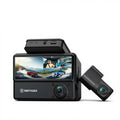
A 3-channel dash cam (front camera + rear camera + interior cabin camera) gives you the same road coverage as a standard dual-channel setup, plus documentation of every passenger interaction in your vehicle.
Not all interior cameras are equal, and the difference matters most at night — when rideshare incidents are most likely.
For rideshare documentation, color footage is meaningfully better: more persuasive in disputes, more identifiable in incident reports, and more useful if a situation escalates to law enforcement.

| Model | Channels | Interior Lens | Night Vision Tech | WiFi Link | Price* |
|---|---|---|---|---|---|
| F17 | 3-Channel | 1080P | IR (Black & White) | 5.8GHz / 8 Mb/s | $159.99 |
| VP40 | 4-Channel | 1080P + 1080P | IR + Night Vision | 5.8GHz / 8 Mb/s | $219.99 |
| F17 Elite ★ | 3-Channel | 1080P (Sony) | Full Night Color | WiFi 6 / 30 Mb/s | $239.99 |
*Spring 2026 sale pricing — check each product page for current offers.
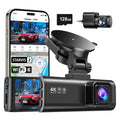
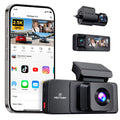
The F17 Elite is built around the three things that matter most for rideshare: a full-color interior camera, the fastest WiFi in the lineup, and quality sensors across all three channels.
Premium Hardware Camera Breakdown:
WiFi 6 at 30 Mb/s is the fastest clip transfer available in the current REDTIGER lineup, ensuring you can pull clips instantly between rides. The F17 Elite also includes NiteGuard™ parking mode and an interactive 3.18-inch touchscreen with advanced voice control.
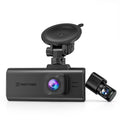
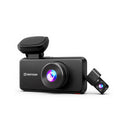
The F17 is a capable 3-channel entry point. The front camera is 4K (upscaled), while the rear and interior are 1080P. The interior camera uses standard IR night vision — producing sharp black-and-white footage in low light. For rideshare drivers on a tighter budget who want interior coverage and can accept monochrome night footage, the F17 is a solid starting point with a hardwire kit included.
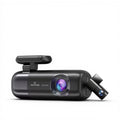
The VP40 adds a fourth camera — featuring two interior cabin lenses rather than one — for ultra-wide cabin coverage at $219.99. Front and rear record at 2.5K. If you drive a larger multi-row vehicle like a van or large SUV where a single interior camera might miss passengers in the far back row, the VP40's dual-interior configuration is worth considering.
If you use your vehicle for logistics or delivery services rather than passenger transport, an interior camera isn't relevant — and the REDTIGER F7NA remains the strongest 2-channel choice at $159.99, featuring native 4K front recording and WiFi 6 at 20 Mb/s.
Both Uber and Lyft explicitly permit drivers in the US to use dash cams. In most US states, video recording inside a vehicle does not require passenger consent. However, audio recording is regulated differently — some jurisdictions require all parties to consent before recording audio (two-party or all-party consent states).
Before enabling audio recording, we strongly advise checking your specific state's wiretapping laws, your platform's current terms, and placing a visible window sticker indicating a recording device is in use. This satisfies disclosure requirements in most major cities.
F17 Elite: The ultimate professional tool. Full-color cabin night vision, 4K front, 2.5K rear, and 30 Mb/s WiFi 6 for rapid evidence management ($239.99).
F17: Functional 3-channel security with monochrome IR night vision and bundled hardwire kit ($159.99).
VP40: 4-channel coverage featuring dual interior cameras to capture wider passenger van cabin rows ($219.99).
Yes — both Uber and Lyft permit dash cams in the US. The legal questions are more specific: audio recording is regulated differently than video recording, and consent requirements vary by state. Video-only recording in a vehicle is generally permitted in most US states. If your dash cam captures audio, check your state's consent laws and your platform's current recording policy before your next shift.
For passenger transport, yes — the interior camera is the most important feature to prioritize. Disputes that result in driver deactivation almost always involve passenger interactions, not road incidents. The exterior cameras capture what happens on the road; the interior camera captures what happens in your vehicle. A 3-channel system covers both.
Infrared (IR) night vision produces black-and-white footage — functional for detecting motion and general activity, but lacking color detail. Full Night Color technology — used in the REDTIGER F17 Elite's interior camera — produces color footage in near-zero light conditions. Color footage is more useful for identifying passengers and presenting evidence in a formal dispute.
WiFi-connected dash cams let you transfer footage to your phone via the companion app without removing the SD card. WiFi 6 models operating at 20–30 Mb/s can pull a 60-second clip in roughly one minute or less. For the fastest in-app clip transfer in the REDTIGER lineup, the F17 Elite (30 Mb/s via WiFi 6) is the top option.
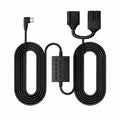
The basics are the same as a 2-channel setup — power cable to the 12V port or hardwire kit, adhesive mount on the windshield, rear camera cable run to the back. The interior camera typically mounts near the rearview mirror, angled toward the rear passenger area, connected to the main unit by a short cable. For parking mode, a hardwire kit is required regardless of channel count — it is included with both the REDTIGER F17 and F17 Elite.
Don't let a false platform complaint affect your driver rating or account status. The REDTIGER F17 Elite delivers 4K road-facing evidence, 2.5K rear protection, and full-color cabin night vision to secure objective proof when you need it most.
Get the REDTIGER F17 Elite Kit →