



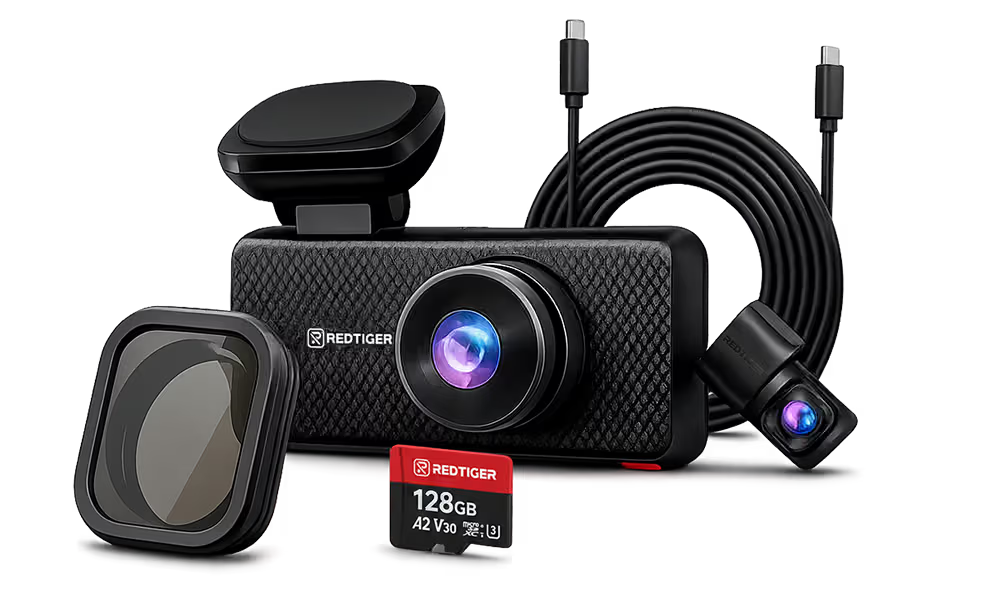


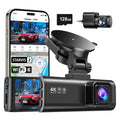

















4K Buying Checklist
Eight Specs. One Better 4K Decision.
A 4K label tells you the output file size. It does not establish native detail, night readability, rear coverage, reliable storage, or quick clip retrieval. Use these eight shopping benchmarks before comparing extras.

How to use it
A spec passes only when you can verify the number and its context.
Each checkpoint uses the same four-part test:
A model does not need to “win” every row. The right camera passes the gates tied to your driving risks. A driver who prioritizes rear-end evidence may weight rear resolution more heavily; a driver who must share clips at the roadside may care more about transfer speed and retrieval steps.
These are editorial shopping benchmarks, not certification requirements. The 60-second export target is a workflow test, not a measured speed promise for any model.
01 — Verify the number.
02 — Confirm which channel it applies to.
03 — Test the real workflow.
04 — Preserve unresolved gaps.
The 8-spec checklist
The 8-spec checklist
Spec 1 — ≥8.29 MP Native Capture for 3840×2160 at ≥30 fps
Threshold: For a defensible native-4K claim, look for a sensor and capture path that can record at least 3840×2160—approximately 8.29 million image pixels—at 30 frames per second or more.
Why it matters: A camera can export a 3840×2160 file even when the sensor captured fewer pixels and processing enlarged the image. Upscaling increases the file dimensions; it does not restore detail the sensor never recorded. Native capture gives the system more real spatial information before compression, exposure, motion, and glare reduce what survives in a frame.
How to verify: Find the exact sensor model, effective-pixel count, recording resolution, and frame rate. Sony’s IMX678 specification lists approximately 8.40 million effective pixels and recommended recording pixels of 3840×2160. If a listing says only “4K” without a traceable sensor or native-capture statement, treat native status as unverified.
REDTIGER example: F7NA publishes IMX678 native 4K front recording at 3840×2160 and 30 fps. F77 publishes dual IMX678 native 4K. F7NP publishes 4K front output, but its current sensor information is inconsistent across source text; do not treat it as verified native 4K until the exact capture chain is confirmed.
Sources: Sony IMX678 sensor specification , REDTIGER F7NA product listing , REDTIGER F7NP product listing , REDTIGER F77 product listing
Spec 2 — ≥1/1.8″ Sensor Format with Approximately 2.0 μm Pixels
Threshold: Use a Type 1/1.8 sensor with roughly 2.0 μm pixels as a strong 2026 benchmark for a native-4K front camera—not as a universal requirement for every budget.
Why it matters: Resolution describes how many pixels are recorded. Sensor format and pixel size help describe how much light the imaging surface can collect before processing. Larger pixels and a larger sensor can support cleaner low-light input, but they do not operate alone: exposure time, HDR method, lens aperture, image processing, compression, and windshield reflections still affect the result.
How to verify: Read the sensor manufacturer’s specification rather than a reseller summary. Confirm the format, effective pixels, unit-cell size, and recommended recording pixels belong to the exact sensor named in the camera. Do not assume every “STARVIS 2” product uses IMX678 or the same pixel size.
REDTIGER example: Sony documents IMX678 as Type 1/1.8 with 2.0 μm pixels. F7NA identifies IMX678 for the front channel, while F77 identifies it for both front and rear. F7NP should remain “sensor verification required” until the current product page and manual agree.
Sources: Sony IMX678 sensor specification , REDTIGER F7NA product listing , REDTIGER F7NP product listing , REDTIGER F77 product listing
Spec 3 — f/1.8 Aperture Plus HDR/WDR Processing
Threshold: Screen for an f/1.8-class lens and published HDR or WDR support on the primary 4K channel.
Why it matters: A wider aperture can admit more light, while HDR/WDR can help manage scenes containing bright headlights, dark road edges, tunnels, and backlit plates. Neither number guarantees night readability. A wide aperture can still produce blur or flare, and HDR implementation varies. The threshold is a reason to inspect sample footage, not a substitute for it.
How to verify: Confirm the aperture applies to the front 4K lens, identify which channels receive HDR/WDR, and review unedited nighttime samples with movement. Look for headlight clipping, windshield glare, edge softness, motion blur, and whether plate characters remain distinguishable across several frames—not one ideal still image.
REDTIGER example: F7NA lists f/1.8 and front HDR. F7NP lists front HDR, but its aperture appears as f/1.8 in one table and f/1.5 elsewhere. Confirm the exact variant rather than treating either aperture as settled. The evidence reviewed does not establish a reliable exact aperture for F77.
Sources: REDTIGER F7NA product listing , REDTIGER F7NP product listing , REDTIGER F77 product listing
Spec 4 — 140°–160° Front Field of View
Threshold: For general road use, start with a published front FOV between 140° and 160° and verify whether the number is diagonal or horizontal.
Why it matters: A wider lens captures more adjacent-lane and intersection context, but making the view extremely wide reduces the number of pixels assigned to distant objects and can increase barrel distortion. A narrower view preserves more detail per object but may miss vehicles entering from the side. The useful range is a balance, not a contest for the largest number.
How to verify: Ask how FOV was measured, compare edge distortion, and view a freeze-frame containing vehicles at the center and edges. Mounting position matters: a camera pushed far to one side or aimed too low can waste part of the published coverage.
REDTIGER example: F7NA lists 160° front and 140° rear angles. F7NP mentions 170° front and 140° rear, but other page sections are not aligned on viewing angle. Confirm the variant and measurement method. No reliable exact F77 viewing angle was established in this review.
Sources: REDTIGER F7NA product listing , REDTIGER F7NP product listing , REDTIGER F77 product listing
Spec 5 — ≥1080p Rear Recording; Choose 4K Rear for Rear-Evidence Priority
Threshold: Use 1080p as an editorial rear-channel starting point for comparing dual-camera 4K systems. Choose native 4K rear when rear plate detail and rear-end evidence are priority use cases.
Why it matters: “4K dash cam” often describes only the front channel. After a rear impact, the most useful view may come from the lower-resolution camera. A 1080p rear channel can document general traffic and impact context, but it has less spatial detail for distant plates than a native-4K rear system.
How to verify: Read the simultaneous recording modes. Some cameras reduce resolution when both channels operate, and some headline the front resolution while hiding the rear specification. Confirm the rear sensor, actual saved-file dimensions, frame rate, and whether both streams remain active in parking mode.
REDTIGER example: F7NA and F7NP publish 1080p rear recording. F77 publishes dual native 4K with IMX678 front and rear. The practical choice is not automatically F77: use dual 4K when the rear evidence gain justifies the storage and price difference.
Sources: REDTIGER F7NA product listing , REDTIGER F7NP product listing , REDTIGER F77 product listing
Spec 6 — 5 GHz Wi‑Fi Plus a ≤60-Second Export Test
Threshold: Prefer 5 GHz-class Wi-Fi for phone retrieval. Use a 60-second target to test connecting, finding, downloading, and saving one representative incident clip. This is an editorial workflow benchmark, not a guaranteed transfer time.
Why it matters: The camera can record excellent footage and still fail the real-world task if retrieval is confusing or slow. Published network speed is only one component. Clip length, encoding, phone performance, app behavior, connection setup, and whether the file reaches the phone gallery all affect the time to share evidence.
How to verify: Do not compare Mb/s and MB/s as if they were the same unit; one byte equals eight bits. Record a normal clip, start with Wi‑Fi off, and time the full process: connect, find the event, preview the correct channel, download it, and locate the exported file. Repeat after the app has been closed.
REDTIGER example: F7NA, F7NP, and F77 list 5.8 GHz Wi-Fi. F7NA uses both 20 Mb/s and 20 MB/s in different sections, and F77 lists 8 Mb/s and 30 Mb/s in different tables. These are conflicting claims, not verified transfer rates. Test your actual phone workflow instead of relying on an advertised maximum.
Sources: REDTIGER F7NA product listing , REDTIGER F7NP product listing , REDTIGER F77 product listing
Spec 7 — ≥256 GB U3/V30 Endurance Storage—or ≥128 GB Built-In eMMC
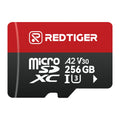
Threshold: For removable storage in a 4K dual-channel system, start at 256GB with an endurance-rated card meeting the camera’s required U3/V30-class sustained-write specification. For built-in storage, use 128GB as a practical comparison point and examine replacement/service implications.
Why it matters: 4K and multi-channel video create a continuous write workload. Capacity determines how much history remains before loop recording overwrites unlocked clips; sustained write performance and endurance affect whether recording remains stable through repeated cycles. Capacity alone does not establish reliability.
How to verify: Follow the exact camera manual. Confirm maximum capacity, supported speed class, recommended formatting method, and whether the camera warns about card errors. Estimate retention from real files recorded with your channel, resolution, frame-rate, codec, and parking settings. A universal hours-per-card table is not reliable without those inputs.
REDTIGER example: F7NA publishes support up to 512GB microSD. Current REDTIGER copy contains conflicting 256GB and 512GB references for F7NP, so confirm its supported maximum before purchase. F77 uses built-in eMMC configurations referenced at 128GB and 256GB, changing the card-maintenance workflow but also making storage replacement different from a removable-card model.
Sources: SD Association video speed classes , SD Association speed-class overview , REDTIGER F7NA product listing , REDTIGER F7NP product listing , REDTIGER F77 product listing
Spec 8 — 3 Parking-Power Checks: Trigger, Cutoff, and Required Hardware
Threshold: Before treating parking mode as usable, verify three items: the recording trigger or mode, the battery-protection cutoff/timer, and the exact hardware required for ignition-off power.
Why it matters: A “24-hour parking mode” label does not mean the camera records indefinitely. Runtime depends on the vehicle battery, temperature, camera draw, enabled channels, recording method, and protection behavior. A normal accessory socket may stop supplying power when the ignition is off.
How to verify: Identify whether the model uses impact detection, time-lapse, motion detection, or a combination. Confirm the compatible hardwire or OBD kit, connector, vehicle voltage, cable route, low-voltage protection, and installation method. Test the completed setup after shutting off the vehicle, then review a test event.
REDTIGER example: F7NA lists time-lapse and G-sensor parking behavior and requires hardwiring; its main description excludes the kit, but bundle options can differ. F7NP gives conflicting kit-inclusion statements, so check the selected package. Match F77 to its compatible power setup and confirm the bundle contents before purchase.
Sources: REDTIGER F7NA product listing , REDTIGER F7NP product listing , REDTIGER F77 product listing
Model map
Model comparison: which checklist gaps matter most?
| Model | Capture | Rear | Retrieval / storage | Best fit | Qualifier |
|---|---|---|---|---|---|
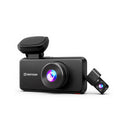
| F7NA | Verified IMX678 native 4K front at 30 fps | 1080p | 5.8 GHz; up to 512GB microSD | Verified native front detail with removable storage | Parking requires hardwiring; kit inclusion depends on the selected bundle |
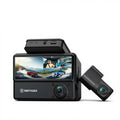
| F7NP | 4K front output; native status requires confirmation | 1080p | 5.8 GHz; published capacity conflicts | Familiar 2-channel format and app access | Confirm sensor, aperture, FOV, storage limit, and kit inclusion for the selected variant |
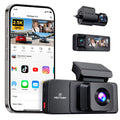
| F77 | Verified dual IMX678 native 4K | Native 4K | 5.8 GHz; built-in eMMC | Front-and-rear detail plus internal storage | Choose the eMMC version and confirm kit contents; published transfer-rate claims conflict |
10-minute verification
The 10-minute verification workflow
-
01
Confirm the exact front and rear sensor models.
-
02
Open one saved front and rear file and inspect its real dimensions and frame rate.
-
03
Review moving nighttime footage, not only a marketing still.
-
04
Confirm the FOV measurement method and inspect edge distortion.
-
05
Time one phone export from Wi‑Fi off to file saved.
-
06
Confirm the storage medium, capacity, speed/endurance requirement, and format procedure.
-
07
Test event locking and make sure the relevant channel files are protected.
-
08
Verify the parking-power hardware and battery-protection behavior.
Weight the gates by your evidence risk
Do not average the eight scores into a meaningless total. A driver concerned about hit-and-runs may place rear resolution and parking power above touchscreen controls. A commuter who must share footage at the roadside may prioritize the export test. A hot-climate driver may put power architecture and storage endurance first. Mark each gate as required, preferred, or optional before comparing products. This prevents a long feature list from compensating for failure on the one specification tied to your most important incident scenario.
Bottom line
The best 4K dash cam is not the one with the longest feature list. It is the one whose eight core claims can be traced to a sensor specification, saved file, manual, test clip, or installed power setup. Start with native capture, then protect that detail through optics, coverage, rear recording, retrieval, storage, and parking power.
FAQ
FAQ
Is every 3840×2160 dash cam native 4K?
+
No. A camera can export a 3840×2160 file after upscaling lower-resolution capture. Verify the sensor pixel count and capture path.
Is 30 fps enough for a 4K dash cam?
+
Thirty frames per second is a practical minimum for normal 4K road recording. Exposure, motion, bitrate, compression, and image processing still affect individual frames.
Is a wider 170° lens always better?
+
No. It captures more peripheral context but may increase distortion and make distant objects smaller. Compare sample footage and measurement method.
How much storage should a 4K dash cam support?
+
For removable storage, 256GB is a practical starting point for dual-channel 4K shopping, but actual retention depends on bitrate, codec, channels, frame rate, and settings.
Is 5 GHz Wi‑Fi the same as fast downloads?
+
Not necessarily. Test the complete workflow. Published network speed does not include app navigation, clip processing, phone performance, or export steps.
Does parking mode work without a hardwire kit?
+
It depends on the model and approved power method. Many systems require a compatible hardwire or OBD kit because the normal accessory socket may switch off with the ignition.
Sources
Product listings can change. Check the current manual and package before purchase. These shopping benchmarks do not guarantee plate readability or parking runtime.
- Sony IMX678 sensor specification
- SD Association video speed classes
- SD Association speed-class overview
- REDTIGER F7NA product listing
- REDTIGER F7NP product listing
- REDTIGER F77 product listing
For broader selection, read the daily-driving buyer's guide . For ignition-off power and recording modes, read the parking mode guide .