



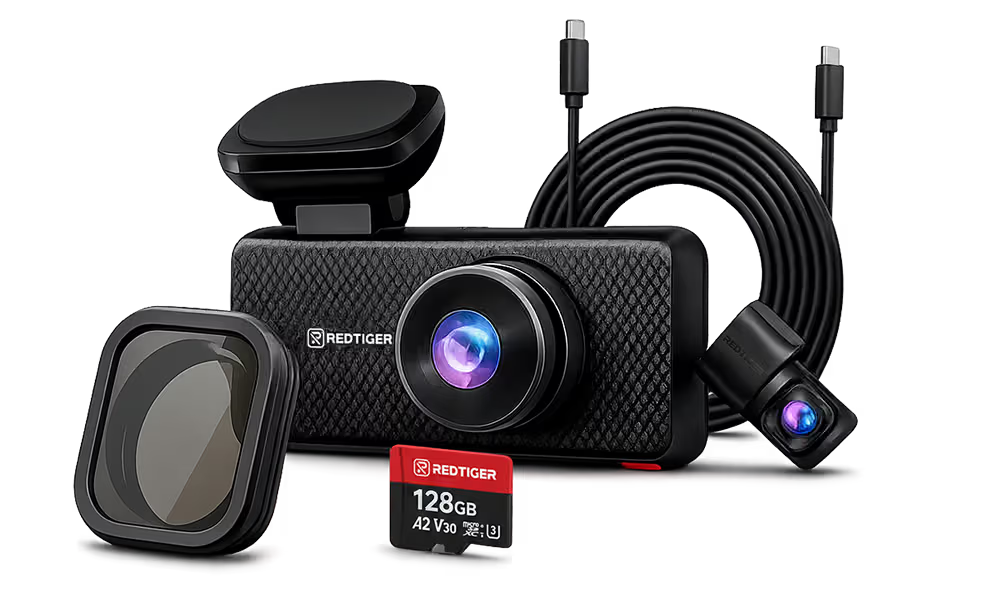



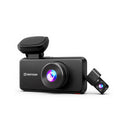
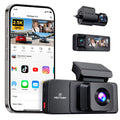

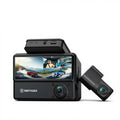















Five technology dimensions determine whether a dash cam produces evidence-grade footage or just footage. This guide covers each dimension, what the current technology ceiling looks like, and where REDTIGER’s 2026 lineup sits across them.
Dimension 1: Image Sensor — The Most Important Spec
The image sensor is the single most important component in a dash cam. It determines night vision performance, dynamic range (the ability to capture detail in both bright and dark areas simultaneously), and the ceiling on usable footage quality.
How Sensor Technology Has Evolved
The dash cam sensor market has moved through three distinct generations:
First-generation CMOS — Front-side illuminated sensors. Limited light-gathering capacity. Produces washed-out highlights (headlights, sunlight through windshield) and noisy, grainy footage in low light.
Sony STARVIS (first generation) — Back-illuminated CMOS (BSI). Light hits the photodiode directly rather than passing through wiring layers first. Meaningful improvement in low-light performance over standard CMOS. Used in many cameras through 2020–2023.
Sony STARVIS 2 — The current performance standard. Back-illuminated architecture with enhanced pixel technology. The IMX678 model — used in REDTIGER’s F7NA and F77 — is an 8-megapixel sensor optimized for automotive low-light applications. REDTIGER’s published data cites a 30% improvement in low-light performance for IMX678-equipped cameras versus earlier platforms.
For a detailed breakdown of STARVIS 2 technology and what IMX numbers mean, see our Sony STARVIS 2 sensor guide.
Why It Matters for Accident Recording
Accident-relevant footage is disproportionately captured in challenging conditions: dusk, dawn, rain, glare from oncoming headlights, underground parking, nighttime. A sensor that loses usable detail in these conditions fails precisely when the footage matters most.
The IMX678’s back-illuminated architecture captures more light per pixel — which means cleaner, more detail-rich footage in exactly the conditions where incidents are most likely to be disputed.
Dimension 2: Resolution — Native vs Upscaled
Resolution determines how much detail the camera can record in a single frame. The key distinction in 2026 is not just which resolution tier a camera claims, but whether the 4K output is native or upscaled.
| Resolution Type | What It Means | License Plate at Distance |
|---|---|---|
| 1080P (native) | Sensor captures at 1920×1080 | Readable at ~20–25 feet |
| 4K upscaled | Sensor captures below 4K; output scaled to 3840×2160 | Better than 1080P; interpolated detail |
| 4K native | Sensor physically captures at 3840×2160 | Readable at 40–50+ feet in good light |
For accident recording, native 4K with a quality sensor is the combination that produces footage you can zoom into and actually read a license plate from — not just footage that exists.
For the full resolution comparison, see our 1080P vs 2K vs 4K guide.
Dimension 3: WiFi Transfer Speed — Evidence Access When It Counts
After an incident, how quickly you can get footage off the camera determines whether you can share it before the other driver leaves the scene, or hand it to police on the spot.
WiFi speed on dash cams has advanced significantly:
| WiFi Standard | Typical Transfer Speed | 60-Second 4K Clip |
|---|---|---|
| 2.4GHz (older) | 2–4 Mb/s | 5–10+ minutes |
| 5GHz (standard) | 8 Mb/s | ~2–3 minutes |
| WiFi 6 (5.8GHz) | 20–30 Mb/s | Under 1 minute |
REDTIGER’s WiFi 6 models (F7NP, F7NA, F7N Elite at 20 Mb/s; F17 Elite at 30 Mb/s) represent the current performance standard for consumer dash cams. The F77 uses 5.8GHz at 8 Mb/s — capable but not WiFi 6. WiFi 6 is the spec to look for if fast post-incident footage access is a priority.
Dimension 4: Parking Mode — Protection When You’re Not There
Parking mode extends the camera’s coverage to include the time your vehicle is unattended. The technology has evolved from simple motion detection to multi-mode intelligent recording:
Basic collision detection — G-sensor triggers recording on physical impact only. Misses incidents where there’s no physical contact (vandalism, attempted break-in).
Time-lapse — Camera captures frames at intervals during parking. Lower power draw than continuous. Captures events that happen near the vehicle.
24-hour continuous — Full video recording throughout the parking session. Highest storage and power requirements. Most complete record.
Multi-mode (Super Auto-shield / NiteGuard™) — Camera selects the appropriate mode based on conditions. REDTIGER’s F7N Elite uses Super Auto-shield (loop + time-lapse + collision combined). The F17 Elite’s NiteGuard™ applies Full Night Color processing to time-lapse frames — producing color parking footage in near-darkness rather than grainy IR footage.
All parking modes require a hardwire connection. All REDTIGER parking-mode cameras include low-voltage cutoff protection. For a detailed breakdown, see our parking mode battery drain guide.
Dimension 5: Temperature Tolerance — Reliability in the Real World
A dash cam mounted on a windshield in summer sun experiences extreme temperatures. Dashboard temperatures in direct sun can exceed 140°F in some climates. A camera that fails in heat is not a reliable safety tool.
Lithium battery: Standard internal battery. Performance and capacity degrade in heat. Maximum operating temperature typically 140–149°F (60–65°C). After repeated high-temperature cycles, the battery loses capacity.
Supercapacitor: No chemical degradation in heat. Stores and releases energy electrostatically. REDTIGER’s supercapacitor-equipped cameras (F7NA, F7NP) are rated to 158°F (70°C). In hot climates, the supercapacitor remains reliable where a lithium battery would degrade over time.
For fleet operators and drivers in high-temperature regions (Southwest US, summer in the South), supercapacitor technology is the meaningful differentiator for long-term reliability.
How REDTIGER’s 2026 Lineup Sits Across All Five Dimensions
| Model | Sensor | Resolution | WiFi | Parking | Temp | Price |
|---|---|---|---|---|---|---|
| F7NP | STARVIS 2 | 4K upscaled | WiFi 6 / 20 Mb/s | Time-lapse + collision | Supercap | $109.99 |
| F7NA | IMX678 STARVIS 2 | Native 4K | WiFi 6 / 20 Mb/s | 24-hour | −4°F–158°F | $159.99 |
| F17 Elite | STARVIS 2 (×3) | 4K front / 1080P ×2 | WiFi 6 / 30 Mb/s | NiteGuard™ 24H | Supercap | $239.99 |
Spring 2026 pricing. Verify current pricing on each product page.
"4K" refers to exported video files with a resolution of no less than 3840 × 2160.
Frequently Asked Questions
What technology makes a dash cam better for accident recording?
Three factors matter most for accident recording: sensor quality (Sony STARVIS 2 captures usable footage in low light, which is when many incidents occur), native 4K resolution (for license plate legibility at distance), and fast WiFi transfer (for sharing footage on the spot). The REDTIGER F7NA combines all three: Sony STARVIS 2, native 4K, and WiFi 6 at 20 Mb/s.
What are the technical benefits of high-sensitivity sensors in night vision?
Back-illuminated CMOS sensors (BSI), such as Sony STARVIS 2, position the photodiode at the top of each pixel rather than behind wiring layers. This means more light reaches the light-sensing element per pixel. The practical result: less noise, more detail, and better dynamic range in low-light conditions. For night driving, this means the camera can simultaneously expose for dark roadway areas without blowing out headlights or streetlights — producing footage where both the road ahead and the vehicle surroundings are legible.
How does WiFi 6 improve a dash cam?
WiFi 6 at 5.8GHz transfers footage at 20–30 Mb/s — fast enough to send a 60-second 4K clip to your phone in under a minute. The practical difference: after a fender-bender, you can have relevant footage on your phone and ready to show to police or the other driver before they leave the scene. Older WiFi standards at 2–4 Mb/s take several minutes for the same clip.
Why do top dash cams use supercapacitors instead of batteries?
Supercapacitors store energy electrostatically rather than chemically. They don’t degrade in heat, which matters because dash cams mounted on windshields can experience temperatures exceeding 140°F in summer. A lithium battery loses capacity after repeated high-temperature cycles; a supercapacitor does not. For long-term reliability in year-round use, supercapacitor technology maintains consistent performance where a battery camera would degrade.
What is the current technology ceiling for consumer dash cams?
In 2026, the ceiling is: native 4K with Sony STARVIS 2 sensor (both front and rear cameras), WiFi 6 at 20–30 Mb/s for fast footage access, 24-hour continuous parking mode with low-voltage cutoff, and supercapacitor for temperature-reliable operation. The REDTIGER F77 ($225.99) achieves native 4K on both cameras with dual sensors; the F17 Elite ($239.99) achieves the highest WiFi speed (30 Mb/s) and the most comprehensive parking mode (NiteGuard™).
Technology-first buyers: The REDTIGER F7NA ($159.99) is the best balance of every technology dimension — native 4K, Sony STARVIS 2, WiFi 6, 24-hour parking, supercapacitor, and −4°F to 158°F temperature rating. For the highest WiFi speed and three-channel coverage, the REDTIGER F17 Elite ($239.99) is the flagship.


Leave a comment
All comments are moderated before being published.
This site is protected by hCaptcha and the hCaptcha Privacy Policy and Terms of Service apply.