



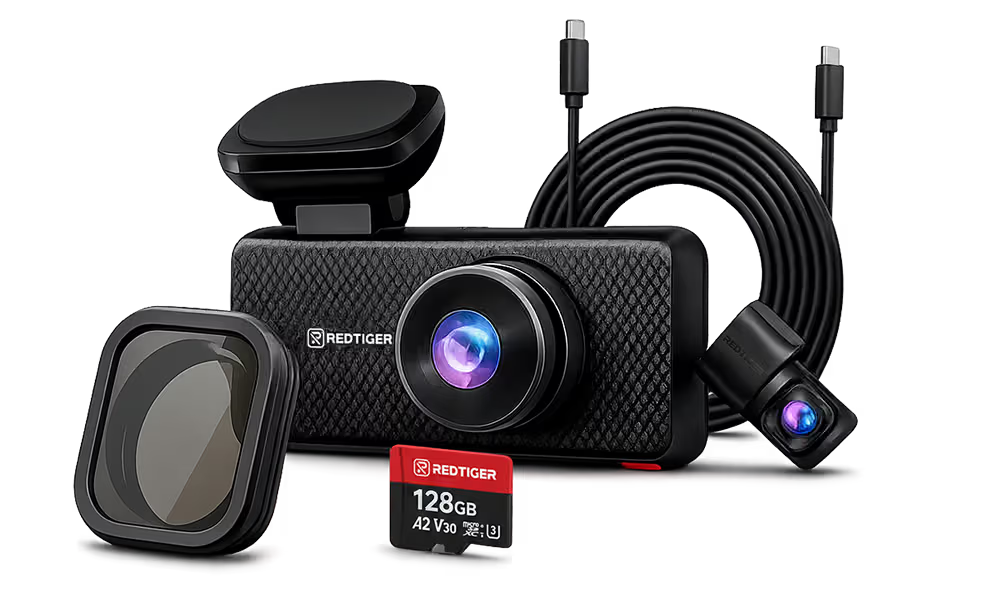


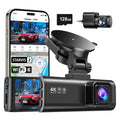

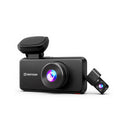


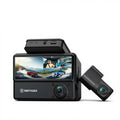















Quick answer: Any dash cam marketed as “front and rear” or “dual channel” includes two cameras — one facing the road ahead and one facing the road behind your vehicle. For most drivers, the REDTIGER F7NA ($159.99) is the best two-camera system in 2026: native 4K front with Sony STARVIS 2, 1080P rear, WiFi 6 at 20 Mb/s, and 24-hour parking mode. If budget is the priority, the REDTIGER F7NP starts at $109.99 with Sony STARVIS 2 and a hardwire kit included.
How Two-Camera Dash Cam Systems Work
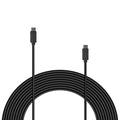
A front and rear dash cam is a single unit with two cameras: one mounts on the windshield facing the road ahead, and a second connects via cable and mounts on the rear windshield facing backward. Both cameras record simultaneously to the same SD card in the front unit. One device covers both directions — no second power connection required for the rear camera.
The rear camera matters for a simple reason: rear-end collisions are among the most common and most disputed incidents on the road. Without a rear camera, your dash cam has no footage of what hit you from behind.
What Separates Front and Rear Dash Cams: Sensor Quality
All two-camera dash cams record front and back. What varies is what the sensor actually captures — particularly in the conditions where incidents are most likely to be disputed: low light, dusk, dawn, nighttime, and rain.
The sensor is the core differentiator in dual-channel systems.
Sony STARVIS 2 (IMX678) — Used in REDTIGER’s F7NA and F77. Back-illuminated CMOS technology optimized for low-light capture. REDTIGER’s published data cites a 30% improvement in low-light performance for IMX678-equipped cameras versus earlier sensor platforms. Native 4K capture: the sensor physically records at 3840×2160.
Sony STARVIS 2 (other models) — Used in REDTIGER’s F7NP and F7N Elite. Same STARVIS 2 sensor generation with strong low-light performance. Output is upscaled to 4K rather than native — the sensor captures at lower resolution and the processor scales up.
Rear cameras across all REDTIGER dual-channel models record at 1080P (1920×1080). The rear camera’s job is to capture what’s behind you — license plates, vehicles, road markings. 1080P is sufficient for this purpose at typical following distances.
REDTIGER Front and Rear Models — Full Sensor Comparison
| Model | Front Resolution | Front Sensor | Rear Resolution | WiFi | Parking | Price |
|---|---|---|---|---|---|---|
| F7NP | 4K (upscaled) | Sony STARVIS 2 | 1080P | WiFi 6 / 20 Mb/s | Time-lapse + collision | $109.99 |
| F7N Elite | 4K (upscaled) | Sony STARVIS 2 | 1080P | WiFi 6 / 20 Mb/s | Super Auto-shield | $139.99 |
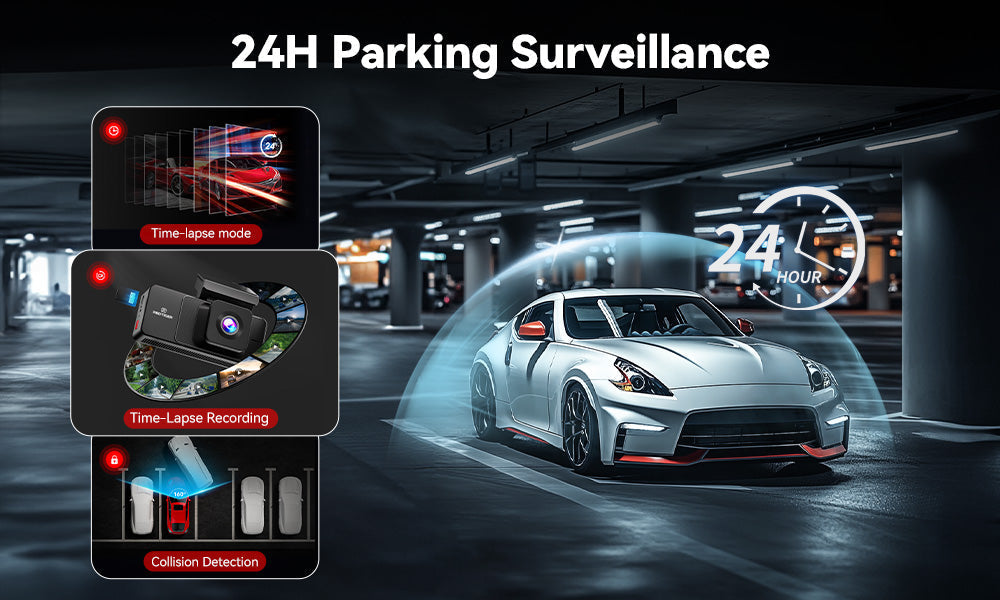
| F7NA ★ | Native 4K | Sony IMX678 STARVIS 2 | 1080P | WiFi 6 / 20 Mb/s | 24-hour | $159.99 |
| F77 | Native 4K | Sony IMX678 STARVIS 2 | Native 4K | 5.8GHz / 8 Mb/s | 24-hour | $225.99 |
Spring 2026. Verify current pricing on each product page.
"4K" refers to exported video files with a resolution of no less than 3840 × 2160.
Which Two-Camera System Is Right for You
Under $130 — F7NP ($109.99)
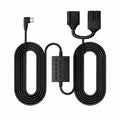
The most accessible entry into STARVIS 2 dual‑channel recording. Upscaled 4K front (which refers to exported video files with a resolution of no less than 3840×2160), 1080P rear, WiFi 6 for fast clip transfer, supercapacitor, and a hardwire kit included free. Parking mode covers time‑lapse and collision detection. Best for drivers who need solid front‑and‑rear coverage without spending $150+.
$130–$150 — F7N Elite ($139.99)
Adds Super Auto-shield parking mode (loop + time‑lapse + collision combined), built‑in GPS, and a touchscreen. Still upscaled 4K front. Best for drivers who prioritize comprehensive parking coverage over native 4K resolution, which refers to exported video files with a resolution of no less than 3840×2160.
Best overall — F7NA ($159.99)
Native 4K front with Sony STARVIS 2 — the sensor that physically captures at full 3840×2160. WiFi 6 at 20 Mb/s transfers a 60-second clip in under a minute. 24-hour parking mode. Supercapacitor rated −4°F to 158°F. The strongest two-camera system for evidence quality at this price.
4K front and rear — F77 ($225.99)
The only REDTIGER dual-channel model where both cameras use Sony STARVIS 2 recording natively at 4K. Built-in eMMC storage (no SD card needed). WiFi at 8 Mb/s — slower transfer than the F7NA. Right for drivers who specifically need full 4K rear footage.
For a detailed comparison of all REDTIGER front-and-rear models including three-channel options, see our front and rear dash cam buying guide.
What the Rear Camera Actually Captures
A 1080P rear camera at 1920×1080 resolves sufficient detail for the rear camera’s primary job: capturing a vehicle that hits you from behind, recording its plate number, and documenting the approach before impact. At typical following distances on a highway or city street, 1080P rear footage is usable as evidence.
Where rear resolution matters more: very high-speed incidents where the following vehicle is far back in the frame, or situations where you need to read a plate on a vehicle that was far behind you. For those use cases, the F77’s native 4K rear camera provides more detail.
For most drivers in most incidents — rear-end collisions at city and highway speeds — 1080P rear with a quality front sensor is the right balance. For a full breakdown of what each resolution tier captures, see our 1080P vs 2K vs 4K comparison.
Frequently Asked Questions
Which dash cams have two cameras to record front and back?
Any dash cam described as “front and rear,” “dual channel,” or “dual lens” includes two cameras. The front camera mounts on the windshield and records the road ahead; the rear camera connects via cable and mounts on the rear windshield to record behind the vehicle. REDTIGER’s front-and-rear models include the F7NP ($109.99), F7N Elite ($139.99), F7NA ($159.99), and F77 ($225.99).
Do I need a front and rear dash cam, or is front-only enough?
A front-only camera misses any incident involving what happens behind your vehicle — rear-end collisions, tailgating, and parking lot incidents from behind. Rear-end collisions are among the most common disputed crash types, and without a rear camera, your footage only shows your perspective ahead. For complete coverage, front-and-rear is the better choice for most drivers.
What is the difference in sensor quality between front and rear cameras on a dual-channel dash cam?
In most dual-channel systems, the front camera has a higher-specification sensor than the rear. On REDTIGER’s F7NA, the front camera uses Sony STARVIS 2 capturing natively at 4K; the rear uses a 1080P sensor. This reflects the different roles: the front camera needs to capture maximum road detail and license plates at distance ahead, while the rear camera primarily captures what’s directly behind the vehicle at close range. The F77 is the exception — both cameras use Sony STARVIS 2 at native 4K.
Does the rear camera need its own power connection?
No. The rear camera connects to the front unit via a cable that runs through the vehicle’s headliner and C-pillar trim. Power comes from the front unit — no separate power connection is needed for the rear camera. The cable carries both power and video signal.
How do I install a front and rear dash cam?
The front unit mounts on the windshield and connects to power (either the 12V port for basic installation, or a hardwire kit for parking mode). The rear camera cable routes through the headliner and down the C-pillar to the rear windshield. For a detailed installation walkthrough, see our 1080P vs 2K vs 4K comparison guide.
The best front and rear dash cam in 2026: The REDTIGER F7NA ($159.99) — native 4K front with Sony STARVIS 2, 1080P rear, WiFi 6 at 20 Mb/s, 24-hour parking mode. Need to stay under $130? The REDTIGER F7NP ($109.99) brings STARVIS 2 and a free hardwire kit to the entry price point.

Leave a comment
All comments are moderated before being published.
This site is protected by hCaptcha and the hCaptcha Privacy Policy and Terms of Service apply.