



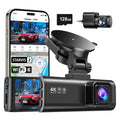
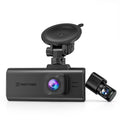

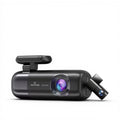
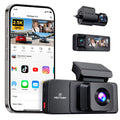

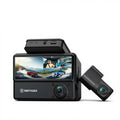




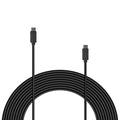


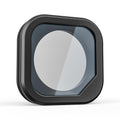
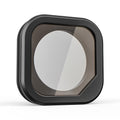
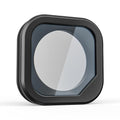





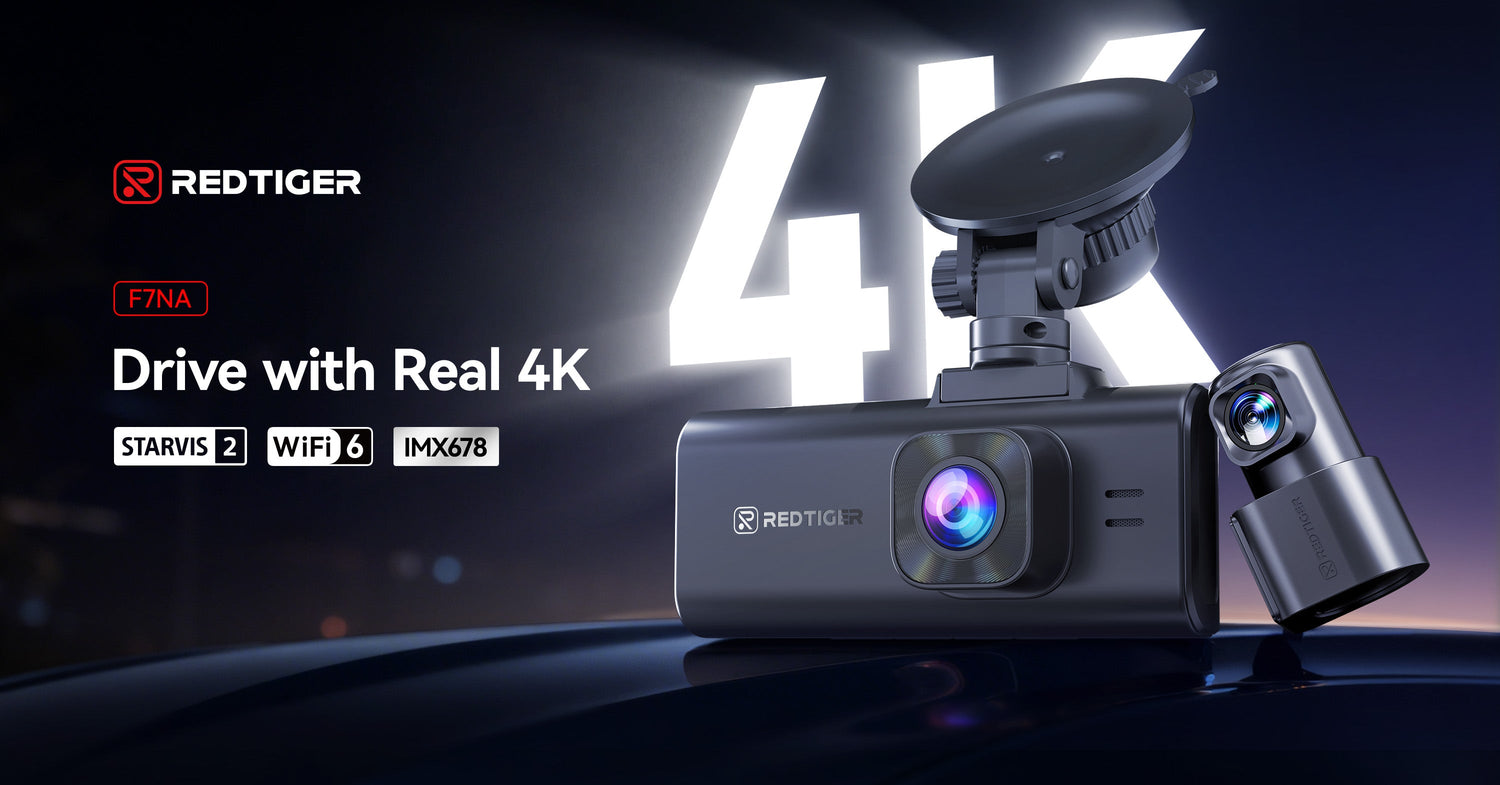
REDTIGER's new F7NA is the latest addition to the brand's F7N series — and it's the most ambitious front-and-rear setup the company has shipped to date. A Sony STARVIS 2 sensor on the front, 4K front recording paired with 1080P rear, WiFi 6 over a 5.8 GHz band, voice control, GPS, ADAS alerts, and a 3.69-inch touchscreen all sit behind a sub-$200 sticker.
On paper, that's a strong package for drivers who've outgrown an entry-level dash cam and want license-plate-readable night footage at a value-conscious price point. The question this review answers is more practical: what do those specs actually buy you, what calculated trade-offs the F7NA makes, and how does it stack up against its own siblings — the F7NT and F7NP — within REDTIGER's lineup?
REDTIGER F7NA: Quick Specs
| Front Sensor | Sony STARVIS 2, 8MP — native 4K (2160P) |
|---|---|
| Rear Resolution | 1080P FHD (rear sensor model not disclosed) |
| Connectivity | WiFi 6, 5.8 GHz, up to 20 Mb/s (~2.5 MB/s) download |
| Display & Control | 3.69-inch touchscreen, GPS, Voice Control |
| ADAS Alerts | Lane Departure Warning, Forward Collision Warning, Forward Vehicle Start Alert |
| Parking Mode | 24-hour supported (requires optional hardwire kit) |
| Thermal Hardware | Supercapacitor, operating range −4°F to 149°F (−20°C to 65°C) |
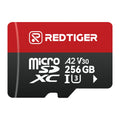
| Storage & Mount | microSD up to 512GB / Suction cup mount |
| Warranty & Price | 2 years (+6-mo direct extension) / $159.99 sale ($189.99 MSRP) |
What the Sony STARVIS 2 Sensor Actually Changes
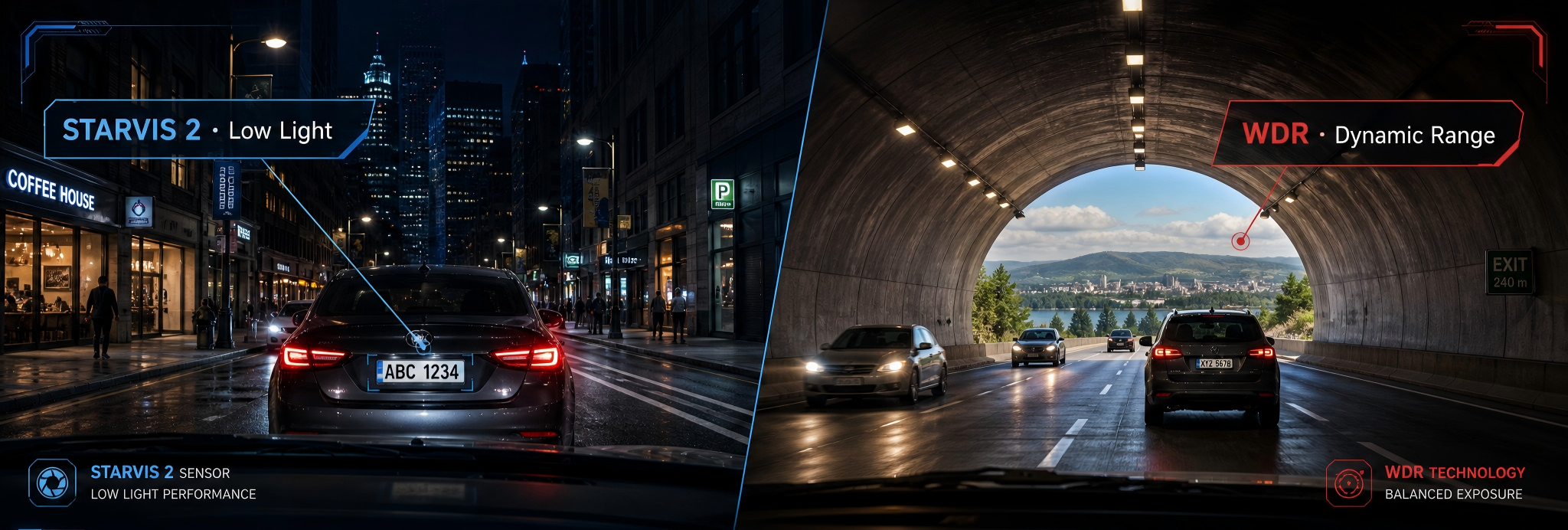
The single biggest reason the F7NA exists at this price point is the Sony IMX678 STARVIS 2. STARVIS 2 is Sony's second-generation back-illuminated sensor architecture, designed specifically for surveillance and automotive use. It improves low-light performance versus the original STARVIS — which was already the de-facto night-vision benchmark.
According to REDTIGER's published technical writeup, the IMX678 features a 30% improvement in low-light performance compared to the IMX335 sensor used in earlier F7N-series models (source: REDTIGER Blog, Sep 2024). Sony positions the STARVIS 2 family more broadly as offering vastly improved near-infrared sensitivity.
In practical terms, this matters in three scenarios that account for most of the footage drivers actually need:
- Reading license plates at night under street lighting, not just under direct headlights.
- Recovering detail in mixed lighting — for example, a parking lot where some areas are lit and others aren't, or a tunnel-to-daylight transition.
- Suppressing headlight glare from oncoming traffic, where weaker sensors blow out the entire frame.
Front 4K + Rear 1080P: Is the Asymmetry a Dealbreaker?
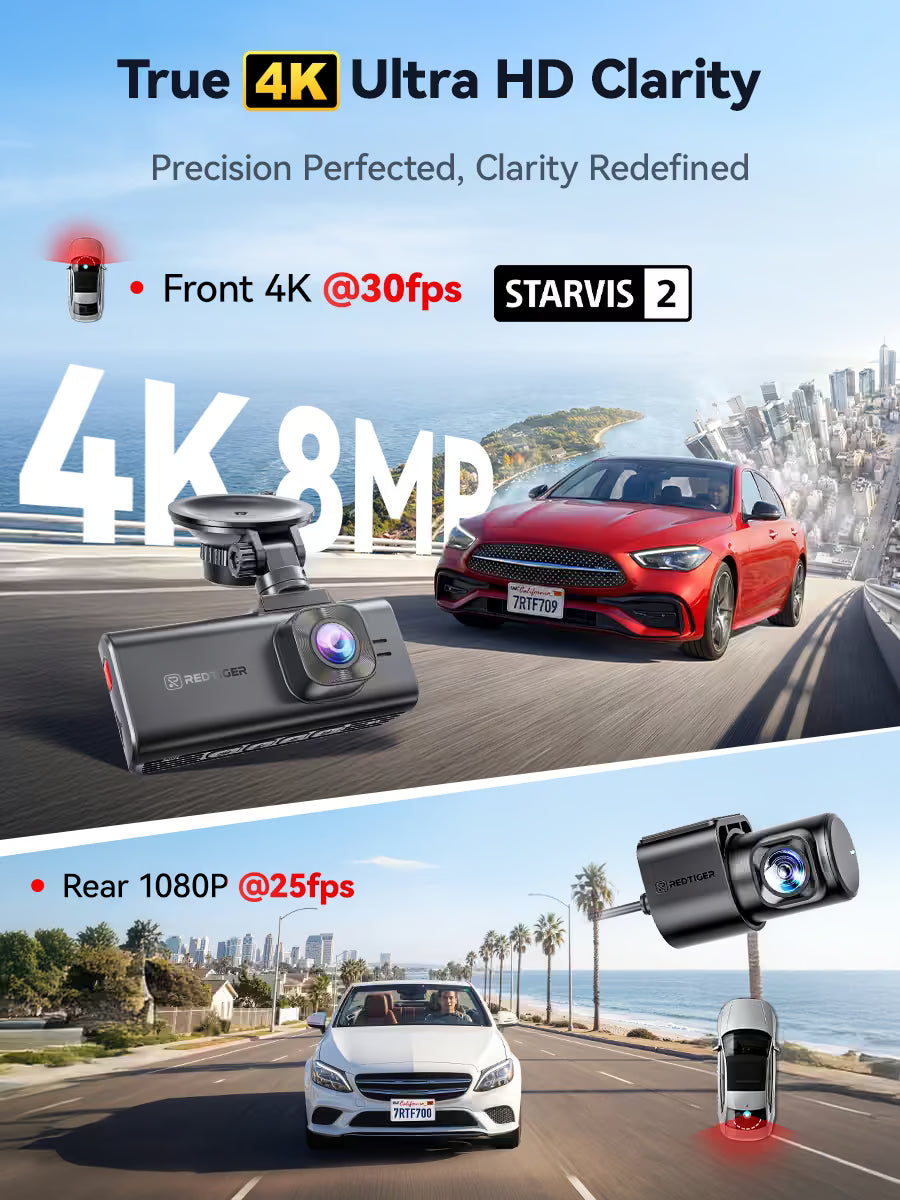
REDTIGER has gone with 4K front, 1080P rear. For most use cases, the front is where you want every available pixel to read license plates and road signs. The rear camera's job is different: it captures rear-end collisions and provides context, where 1080P is genuinely sufficient provided your rear glass is clean and the camera is mounted high enough.
The asymmetry is a dealbreaker only if you regularly need to read license plates of cars several car lengths behind you (e.g., highway tailgating disputes). For everyday driving, this split keeps the price under $200 while maximizing forward evidence.
WiFi 6 at 5.8 GHz: Faster Footage Transfer
The F7NA uses WiFi 6 on the 5.8 GHz band, with REDTIGER quoting up to 20 Mb/s download in interference-free conditions. Why this matters:
- File Size: 4K footage is large. Older dash cams running 2.4 GHz WiFi take minutes to transfer a clip, frustrating users into pulling the SD card.
- Less Interference: 5.8 GHz is less crowded than 2.4 GHz in dense urban areas where Bluetooth and routers cause traffic jams.
When you need to grab footage of an incident at the side of the road and email it to your insurer, the F7NA gets you from "incident happened" to "clip is on my phone" in seconds, not minutes.
24-Hour Parking Mode & Thermal Durability
The F7NA supports 24-hour parking mode, but there are two vital engineering details to understand:
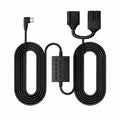
- Parking mode requires a hardwire kit (sold separately). To get continuous power without draining your battery, you must connect a REDTIGER OBD hardwire kit to the fuse box or OBD-II port.
- It uses a Supercapacitor, not a lithium-ion battery. With an operating range of −4°F to 149°F (−20°C to 65°C), it handles extreme dashboard heat drastically better than lithium cells, preventing the swelling and explosive risks associated with cheap dash cams in the summer.
F7NA vs F7NT vs F7NP: Choosing Within the Series

Independent reviewers have confirmed earlier F7N-series models (F7NP/F7NT) use the IMX335 sensor, which captures at 2560×1440 and produces 4K through interpolation (source: Dashboard Camera Reviews). The F7NA's IMX678 is a genuine native-4K sensor, making it the first true-4K entry in the F7N family.
- F7NA (This model): Sony STARVIS 2, native 4K front, WiFi 6. Pick this if night-driving footage and fast downloads are your priority.
- F7NT: The touch-screen variant based on earlier IMX335 hardware (interpolated 4K).
- F7NP: The classic "Upscaled 4K" model. If you are highly cost-sensitive and "near-4K" footage is acceptable, it remains a solid value.
Who the F7NA Is For (and Who It Isn't)
✅ Buy the F7NA if you are:
- A daily commuter who wants the best low-light footage available at this price tier.
- An owner upgrading from an older 1080P single-channel camera ready for native 4K.
- Parking in extreme summer heat (benefits from the Supercapacitor).
❌ Look elsewhere if you need:
- 3-channel coverage (front + rear + cabin) — consider REDTIGER's F17 series instead.
- A native 4K rear camera — the F7NA's rear is 1080P.
- Cloud-connected remote viewing (this is a local WiFi-transfer camera).
Frequently Asked Questions
Is the REDTIGER F7NA's 4K really 4K, or is it upscaled?
The F7NA uses a Sony STARVIS 2 8MP sensor capable of native 4K (2160P) front recording. This is distinct from earlier models which produced 4K through interpolation.
Does the F7NA need a hardwire kit out of the box?
No — it records normally using the included 12V cable while the car is running. A hardwire kit is required only if you want to enable 24-hour parking mode without draining your battery.
Will the F7NA survive summer heat in a parked car?
Yes. The F7NA uses a supercapacitor with an operating range of −4°F to 149°F (−20°C to 65°C), providing massive durability advantages over standard lithium-ion batteries in hot climates.
How long is the warranty?
It carries a 2-year warranty as standard, with an additional 6-month extension (24 months total) for direct purchases through the official website.
Should You Buy the REDTIGER F7NA?
If you want a native 4K front camera with STARVIS 2 night performance, WiFi 6 speeds, supercapacitor durability, and 24-hour parking mode support — all under $200 — the F7NA is one of the strongest options on the market right now.
Check F7NA Price & Availability →

Leave a comment
All comments are moderated before being published.
This site is protected by hCaptcha and the hCaptcha Privacy Policy and Terms of Service apply.