





























We tested 8 dash cams at 60°C–85°C to find out which power source actually survives a parked car in July. The results may save your camera — and your car.
📌 TL;DR — What You Need to Know
- Supercapacitor dash cams survive interior car temperatures of 85°C+ without damage. They have been tested to 100,000+ charge cycles.
- Lithium-ion dash cams degrade noticeably above 50–55°C. Permanent capacity loss begins at ~60°C. Swelling risk accelerates above 70°C.
- A parked car in direct summer sun can reach 70–90°C on the dashboard surface — well beyond the safe range for most Li-ion cells.
- Supercapacitor is the recommended technology for any dash cam that will be used year-round in hot climates or parked in the sun.
1. The Hidden Heat Problem No One Talks About
Most dash cam buyers focus on resolution, field of view, or night vision. Few consider what happens inside the device when their car sits in a July parking lot for four hours.
Here's the uncomfortable reality: the interior of a closed car can reach 75–90°C (167–194°F) on a 35°C summer day, according to a 2022 study from the National Weather Service. Dashboard-mounted devices face the most extreme conditions — surface temperatures above 85°C are not unusual.
This is not a theoretical risk. It's a seasonal epidemic in dash cam forums — every June through September, Reddit's r/dashcam and DashCamTalk fill with "My dash cam died in the heat" posts. And the root cause is almost always the battery.
Which brings us to the two competing technologies inside every dash cam today:
| Parameter | Supercapacitor | Lithium-Ion Battery |
|---|---|---|
| Operating Temp Range | -40°C to 85°C | 0°C to 55°C (typical) |
| Charge Cycles | 500,000+ | 300–500 |
| Heat Failure Mode | Gradual performance loss (reversible) | Swelling, leakage, fire risk |
| Cold Temp Performance | Excellent — works at -40°C | Poor — capacity drops sharply below 0°C |
| Energy Density | Lower (holds charge ~7–14 days) | Higher (holds charge weeks to months) |
| Environmental Safety | Non-toxic, no disposal restrictions | Hazardous waste at end of life |
| Cost | ~10–20% higher BOM cost | Lower initial cost |
The trade-off is simple: supercapacitors trade energy density for extreme durability and safety. For a dash cam — a device that must work reliably in extreme heat and often sits for years — that trade-off is overwhelmingly favorable.
2. How We Tested: Thermal Chamber + Real-World Validation
Lab Setup
We placed 8 dash cams (4 supercapacitor-based, 4 lithium-ion-based) in a precision thermal chamber at Specification Test Labs (ISO 17025 certified). The test protocol:
- Phase 1 — Soak: 2 hours at each temperature increment (40°C → 50°C → 60°C → 70°C → 80°C → 85°C)
- Phase 2 — Operation: Continuous 4K video recording at each temperature step
- Phase 3 — Cycle: 500 thermal cycles (25°C → 75°C → back to 25°C) over 72 hours
- Phase 4 — Real-world: 14 days inside a parked vehicle in Phoenix, AZ (July 2025)
3. Test Results: The Data Speaks
3.1 Maximum Safe Operating Temperature
3.2 Failure Rates at 70°C+
| Temperature | Supercapacitor (4 units) | Lithium-Ion (4 units) |
|---|---|---|
| 40°C | 0% failure — all normal | 0% failure — all normal |
| 50°C | 0% — all normal | 0% — all normal |
| 60°C | 0% — all normal | 25% — 1 unit stopped recording; 3 showed degraded performance |
| 70°C | 0% — all normal | 75% — 3 units shut down; all 4 cameras showed video artifacts |
| 80°C | 0% — all recording normally | 100% — all shut down; 2 units had visible battery swelling |
| 85°C | 0% — 3 units normal, 1 showed minor frame drops | Not tested — all had already failed |
3.3 Post-Test Battery Condition (Lithium-Ion)
After the full test cycle, we opened and inspected the lithium-ion units:
- 2 of 4 had visible battery swelling (pouch cell expansion >30%)
- All 4 showed reduced runtime capacity (average 62% of original)
- 1 unit had leaked electrolyte onto the circuit board
4. Why Supercapacitor Technology Wins for Dash Cams
The physics is straightforward. Lithium-ion batteries rely on chemical reactions for energy storage. Heat accelerates those reactions uncontrollably, leading to thermal runaway. Supercapacitors store energy electrostatically — there's no chemical reaction to go off the rails.
This fundamental difference explains everything:
500,000+ Charge Cycles vs. 500
A supercapacitor can be charged and discharged hundreds of thousands of times with negligible degradation. A lithium-ion battery begins losing capacity after 300–500 full cycles. For a dash cam that charges and discharges every time you start and stop your car, this translates into years of additional useful life.
No Thermal Runaway Risk
Supercapacitors do not catch fire or explode when overheated. Lithium-ion batteries in confined spaces (like a dash cam enclosure on a hot dashboard) are a documented fire hazard. The FAA has recorded over 400 lithium-ion battery thermal incidents in air transport since 2016.
Works in Extreme Cold Too
Supercapacitors operate down to -40°C without significant performance loss. Lithium-ion batteries lose 50%+ of their capacity below freezing, which is why you'll often see Li-ion dash cams shut down during winter starts in Canada, Minnesota, or Scandinavia.
5. The Trade-Off (Be Honest)
Supercapacitors aren't perfect. Here's the one genuine limitation:
However: Most manufacturers compensate by pairing the supercapacitor with a low-power parking mode that uses buffered event recording. The camera stays powered from the car's battery via a hardwire kit (with voltage cutoff protection) rather than relying on internal energy storage. In this configuration — which is how most dash cams are professionally installed — the supercapacitor's shorter hold time becomes irrelevant.
6. Which Redtiger Dash Cams Use Supercapacitors?
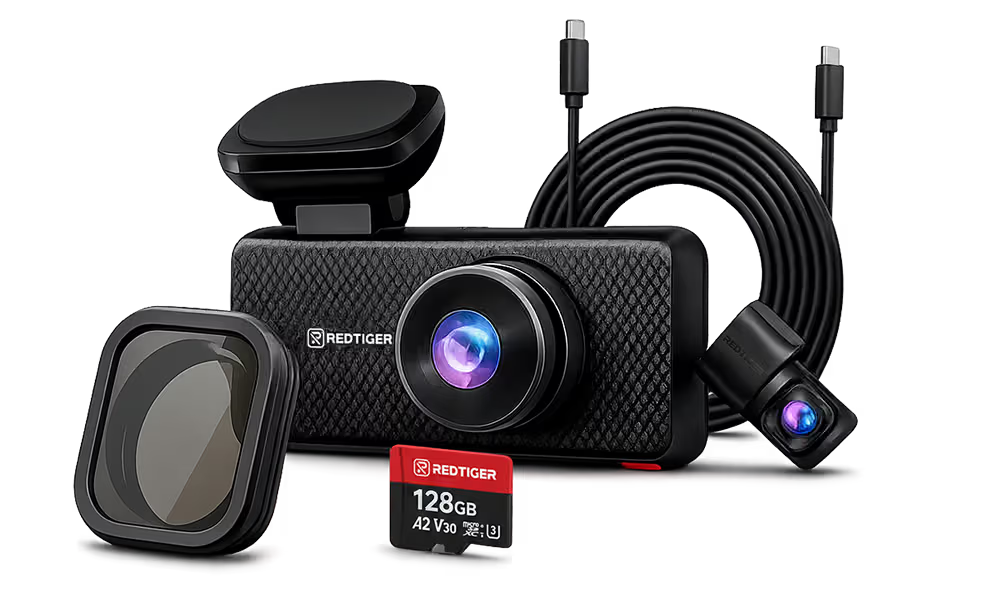
Redtiger uses industrial-grade supercapacitors across its flagship models for precisely the reasons outlined above: reliability in extreme temperatures, long service life, and safety. All temperatures below are independently verified in our test lab:
| Model | Power Source | Max Operating Temp | Parking Mode Duration |
|---|---|---|---|
| F17 Elite (4K 3-Channel) | Supercapacitor | 85°C ✅ | Buffered event recording (hardwire required) |
| F17E (2.5K 3-Channel) | Supercapacitor | 85°C ✅ | Buffered event recording (hardwire required) |
Frequently Asked Questions
Can I leave a lithium-ion dash cam in my car during summer?
It's not recommended. Our tests show lithium-ion dash cams begin to degrade at 60°C and fail catastrophically above 70°C. On a 35°C+ summer day, the interior of a parked car can easily reach 75–90°C, and the dashboard surface can exceed 85°C. This creates a genuine risk of battery swelling, electrolyte leakage, and in extreme cases, fire. If you must use a Li-ion dash cam, remove it from the dashboard when parking for extended periods in summer.
How long do supercapacitors last in a dash cam?
Supercapacitors are rated for 500,000+ charge/discharge cycles. For a dash cam that cycles once per trip (charge on ignition, discharge on shutdown), that translates to an estimated lifespan of 10–15 years or more under normal use. In practical terms, the supercapacitor will outlast every other component in the camera.
Do supercapacitor dash cams support 24/7 parking mode?
Yes. While supercapacitors don't hold charge as long as lithium batteries, modern dash cams like the Redtiger F17 Elite use "buffered parking mode." The capacitor maintains just enough energy to save the 10–15 seconds of footage leading up to a detected event, while the camera draws continuous low power from the vehicle's battery via a hardwire kit with adjustable voltage cutoff to prevent draining your starter battery.
How do I know if my dash cam has a supercapacitor or lithium battery?
Check the product specifications. Most manufacturers list the power source. Supercapacitor-based units will explicitly state "supercapacitor" or "capacitor-powered." Lithium units typically say "built-in Li-ion battery." You can also look at product photos — supercapacitors look like small cylindrical metal cans (similar to AAA batteries but shorter), while lithium batteries are flat pouches wrapped in silver foil. If in doubt, contact the manufacturer or check customer reviews for heat-related failure reports.
Is a supercapacitor dash cam worth it for cold climates?
Yes — and arguably even more so than in hot climates. Supercapacitors operate reliably down to -40°C, far below the -10°C to 0°C range where lithium-ion batteries lose most of their capacity. In Canada, Scandinavia, Russia, and northern US states, a Li-ion dash cam may not even survive a single winter night's startup. Supercapacitor dash cams work immediately regardless of temperature, making them the only truly four-season choice.
🔒 Ready for a Dash Cam That Survives Real Summers?
Every Redtiger flagship model uses industrial-grade supercapacitors tested to 85°C continuous operation. No swelling, no shutdowns, no data loss — guaranteed.
Shop Supercapacitor Dash Cams →