







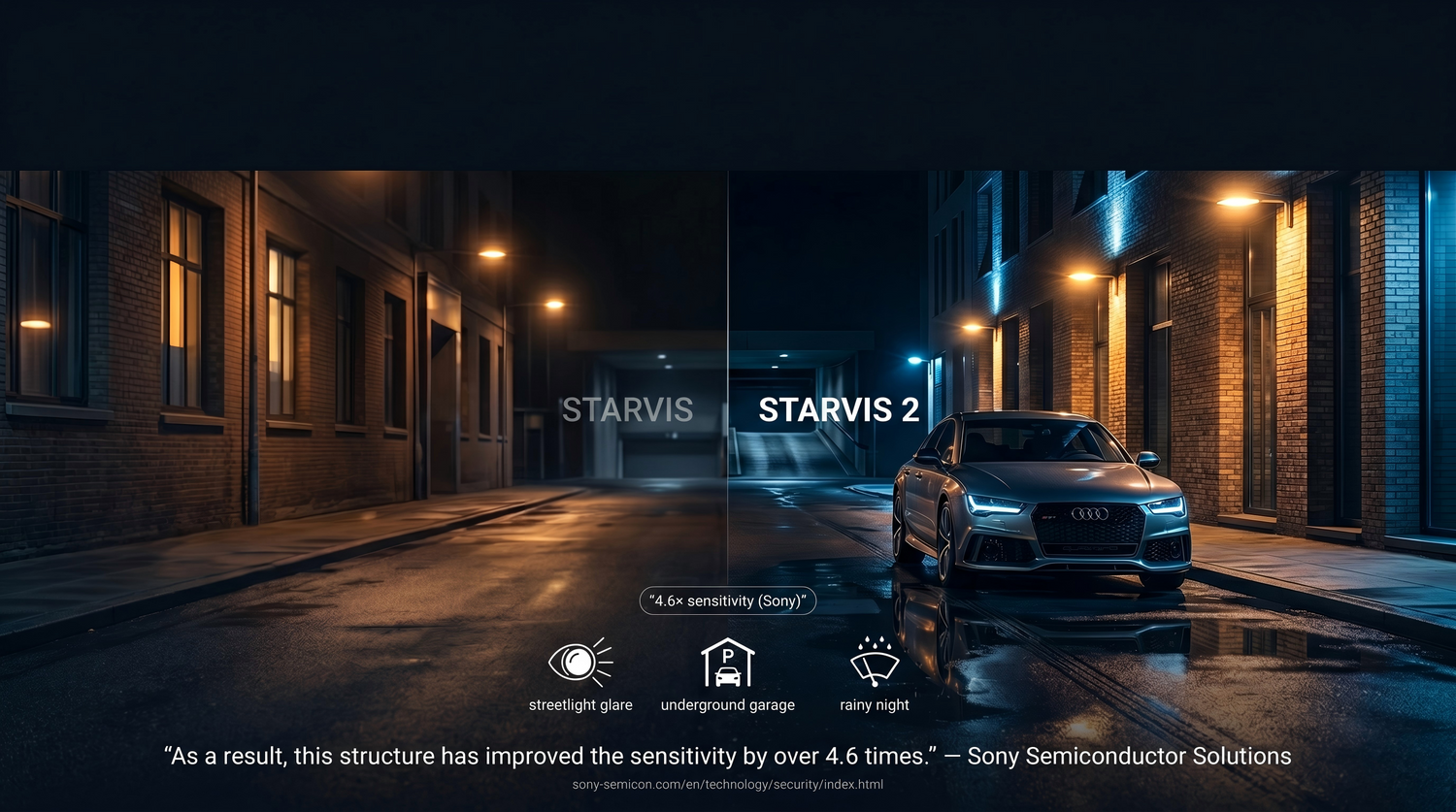
Key takeaway: If you primarily commute in the city and park in residential streets or underground garages, your requirement for a dash cam’s “night vision” is not cinematic footage. It is pragmatic evidence usability: retaining identifiable details when possible, preventing full wash-outs in high-contrast lighting, and keeping scenes usable for incident reconstruction during parking mode.
1. What is Sony STARVIS? The Bottom Line
“STARVIS” is Sony’s trademark for back-illuminated pixel technology used in CMOS image sensors for security camera applications, and it is commonly referenced in dash cam marketing because ultra-low-light performance and noise behavior matter for evidence at night.
Instead of treating STARVIS as a buzzword, anchor it to Sony’s published sensitivity criterion:
“It features a sensitivity of 2000 mV or more per 1 μm² (color product, when imaging with a 706 cd/m² light source, F5.6 in 1 s accumulation equivalent).”
— Sony Semiconductor Solutions (IMX335LQN Flyer) (Source)
Sony also quantifies the structural advantage of back-illumination in its STARVIS technology overview (within Sony’s stated comparison context):
“As a result, this structure has improved the sensitivity by over 4.6 times.”
— Sony Semiconductor Solutions (Source)
2. What is STARVIS 2? The City-Commuting Difference
STARVIS 2 is positioned by Sony as an evolution driven by customer demand to expand dynamic range while preserving low-illuminance performance. This maps directly to city night driving and parking scenes that combine intense highlights (headlights, streetlights, reflective plates) with deep shadows.
“In order to widen the dynamic range further without sacrificing the low-illuminance performance of STARVIS…”
— Sony Semiconductor Solutions (Feature interview, Jan 28, 2022) (Source)
Why this matters in practice: When a dash cam faces high-contrast scenes, the “night problem” is not only brightness. It is highlight control plus noise management plus enough encoded detail to preserve edges and characters when conditions allow.
3. The Physics Behind Blurry Night License Plates
Many drivers see a consistent pattern: daytime is sharp, nighttime plates smear. This usually comes from a stack of constraints, not one defect.
- Low light forces slower shutter and/or higher gain: slower shutter increases motion blur; higher gain increases noise, which then triggers smoothing that can erase fine characters.
- High-contrast overload (HDR pressure): headlights and streetlights can clip highlights; shadows can crush, unless tuning preserves usable dynamic range.
- Bitrate starvation: night scenes contain noise and complex detail. If effective bitrate is too low, compression will discard fine details first, including plate characters and thin edges.
Practical conclusion: “Sensor + tuning + bitrate + lens” is the real formula. A premium sensor helps, but it cannot override conservative tuning or insufficient effective bitrate.
4. The 3 Typical Night Parking Scenarios (And How to Test Them)
To evaluate a dash cam for city nights, test three scenarios that reliably expose failure modes:
💡 Scenario 1: Curbside with Streetlights (High Contrast)
Parking directly under or across from intense, focused light sources.
🏢 Scenario 2: Underground Garage (Ultra-Low Light)
Environments with minimal ambient light and deep shadows.
🌧️ Scenario 3: Rainy Night (Complex Reflections)
Wet asphalt reflects every brake light and headlight, amplifying glare and motion smear.
5. The Pragmatic Buying Framework for City Drivers
If you commute in high-contrast city lighting and rely on parking mode, shop for usable evidence, not “cinematic night video”. Use the checklist below to evaluate any dash cam with repeatable, quantifiable checks.
-
Step 1: Define what “usable evidence” means for you
- Accident evidence while driving: stable highlights (headlights, reflective plates) and motion usability.
- Parking incidents: reliable scene availability (who/what/where/when), not maximum brightness.
- Plate readability: a probability goal, not a guarantee.
-
Step 2: Confirm the sensor class with primary sources
- STARVIS sensitivity criterion (Sony): “2000 mV or more per 1 μm² … 706 cd/m² … F5.6 … 1 s accumulation equivalent.” (Sony source)
- Back-illuminated structure sensitivity claim (Sony): “improved the sensitivity by over 4.6 times.” (Sony source)
- STARVIS 2 design intent (Sony): “widen the dynamic range further without sacrificing the low-illuminance performance…” (Sony source)
-
Step 3: Demand real-world clips that match your city nights
- Streetlight curbside: highlight control, flare, reflective blowout.
- Underground garage: shadow usability and noise behavior.
- Rainy night: reflection handling and motion smear.
-
Step 4: Quantify bitrate risk with a simple 60-second test
- Record a 60-second night clip in your hardest scene and note file size.
- Estimate effective bitrate: Mbps ≈ file_size(MB) × 8 ÷ duration(seconds).
- If codec, fps, or bitrate is not disclosed, this is a practical comparison method for night evidence retention.
-
Step 5: Separate workflow speed from video detail
- Wi-Fi transfer speed affects time-to-share evidence, not how detailed the recording is.
- Example math: at 20 Mb/s in ideal conditions, a 1 GB download is roughly 1,024 MB × 8 ÷ 20 ≈ 410 seconds (≈ 6.8 minutes). Real results vary with interference and device performance.
6. Applying the Framework: REDTIGER F7NA (City Commuting + Parking Use Case)
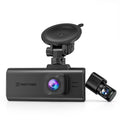
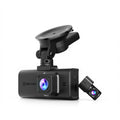
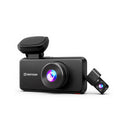
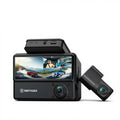
If your real world matches the three night scenarios above (streetlight glare, underground garages, rainy reflections), here is how the checklist maps to a specific model: REDTIGER F7NA.
Verified spec snapshot
- 2-channel recording: Front 4K (2160P) + Rear 1080P
- Front sensor: Sony IMX678 (STARVIS 2 class per product page)
- Lens aperture: F1.8
- Dynamic range mode: Front HDR
- Parking monitoring: supports 24-hour Parking Monitor (requires hardwiring kit, per product page)
- Storage: supports up to 512GB microSD + loop recording
- Evidence workflow: 5.8 GHz Wi-Fi 6, download speed up to 20 Mb/s (claimed “in an interference-free environment”)
- Temperature reliability claim: supercapacitor design, operating range -20°C to 65°C (also shown as -4°F to 149°F)
What this means for night evidence usability
- High-contrast stability: Front HDR is directly relevant to city nights where headlights and streetlights can clip highlights.
- Low-light capture headroom: STARVIS-class sensors are tied to quantifiable sensitivity criteria and back-illuminated structures (see Sony sources above), which is aligned with keeping scenes usable in dark parking environments.
- Dual-channel context: Front 4K plus rear 1080P can improve incident reconstruction even when plates are not perfectly readable frame-by-frame at night.
- Workflow speed: Wi-Fi speed affects how quickly you can retrieve evidence to your phone, which matters after an incident.
Parking mode requirement (important):
“To use this feature, the dash cam needs to be connected to your car's battery using a dedicated Hardwire Kit (Free dashcam with purchase on the official website). Once hardwired, it will automatically record any bumps or collisions while your car is parked, without draining your car battery thanks to its low-voltage protection.”
— REDTIGER F7NA product page (Source)
7. Frequently Asked Questions (FAQs)
Is STARVIS 2 always clearer than STARVIS?
Not necessarily. STARVIS 2 is designed to expand dynamic range without sacrificing low-illuminance performance, but real night clarity also depends on HDR tuning, effective recording bitrate, lens quality, and compression strategy. A stronger sensor can still be limited by conservative tuning or low bitrate.
Why is parking mode more demanding than daytime driving?
Night parking scenes often have minimal ambient light, higher noise, and extreme contrast (streetlights, passing headlights). Parking mode also demands sustained stability and reliable event capture. The goal is evidence usability, not cinematic brightness. Also note that some 24-hour parking monitoring features require hardwiring to the vehicle battery (verify the power method before purchase).
What is Sony’s quantifiable STARVIS sensitivity criterion?
Sony states STARVIS features a sensitivity of “2000 mV or more per 1 μm² (color product, when imaging with a 706 cd/m² light source, F5.6 in 1 s accumulation equivalent)”. (Source)
What is the quantifiable improvement of the STARVIS architecture?
Sony states: “As a result, this structure has improved the sensitivity by over 4.6 times.” (Source)
Why prioritize night vision for evidence and safety?
NHTSA states: “A statistical projection of traffic fatalities for 2023 shows an estimated 40,990 people died in motor vehicle traffic crashes…” (Source)
How clear is the 4K video quality at night? Can it read license plates?
Night license plate readability is not a guaranteed outcome for any dash cam. It varies with speed, distance, glare from headlights and streetlights, shutter speed, HDR tuning, and effective recording bitrate. For a fair comparison, test a 60-second night clip in your real environment and estimate effective bitrate using file size (Mbps ≈ MB × 8 ÷ seconds). Then compare how well edges, characters, and object outlines are retained across the three scenarios in this guide.
Need help? If you have questions about installation, hardwiring for parking mode, or choosing a setup for your driving environment, contact our support team here: https://redtigercam.com/pages/contact-us
- Sony Semiconductor Solutions, IMX335LQN Flyer (STARVIS sensitivity criterion): https://www.sony-semicon.com/files/62/flyer_security/IMX335LQN_Flyer.pdf
- Sony Semiconductor Solutions, STARVIS technology overview (4.6x statement): https://www.sony-semicon.com/en/technology/security/index.html
- Sony Semiconductor Solutions, Feature interview on STARVIS 2 design intent: https://www.sony-semicon.com/en/feature/2022012801.html
- NHTSA Crash Stats (2023 projection, Publication 813561): https://crashstats.nhtsa.dot.gov/Api/Public/Publication/813561
- REDTIGER F7NA product page (spec disclosures, parking hardwire requirement): https://redtigercam.com/products/redtiger-f7na-4k-sony-starvis-2-front-and-rear-dash-cam



Leave a comment
All comments are moderated before being published.
This site is protected by hCaptcha and the hCaptcha Privacy Policy and Terms of Service apply.