





















Dash Cam Supercapacitor vs Battery: What Is the Difference?
|
|
Time to read 8 min

Help Center
Get help with setup, updates, and information

Track My Order
Check Your Package Tracking Status Online

Learn About Dash Cam
The Latest Dash Cam News and Information

Redtiger Player
Play the videos you've recorded on your PC

REDTIGER CAM APP
Download the Redtiger app and use it via a Wi-Fi connection
 Channel
 Sensor
 Video Resolution
 Display
 Lens Aperture
 HDR/WDR
 Wi-Fi
Wi-Fi
 Touch Screen Control
 Voice Control
 Parking Mode
 NiteGuard ™ Parking Mode
 Night vision capability
 GPS Logger
 G-sensor
 Loop Recording
 Storage
 CPL Supported
 Mounting Type (Default)
 Battery & Charging
 Working Temperature
We provide comprehensive pre-sales and after-sales service.

Redtiger offers free shipping on orders totaling $50 or more. We recommend purchasing shipping protection to safeguard your package and money.

Redtiger offers a 30-day money-back guarantee. You may contact us for a no-questions-asked return within 30 days of receiving your order.

Ordering a dashcam through the Redtiger official website entitles you to an additional 6-month extended warranty. This brings the total warranty period to 24 months.

Redtiger provides 24/7 customer service. You can contact us via email or call our customer service hotline directly.
No need to worry about after-sales service—we provide comprehensive after-sales support.
We offer free shipping on qualifying orders with no hidden fees or surprise charges.
Most orders are processed within 1–2 business days and shipped through trusted carriers to ensure safe and timely delivery.
You’ll receive tracking details as soon as your order ships, so you can follow it every step of the way.
From checkout to delivery, we make the process simple and worry-free.

Your satisfaction comes first. If you’re not completely happy with your purchase, you can request a return within 30 days of delivery.
Simply reach out to our support team and we’ll guide you through the process.
Once your item is received and inspected, your refund will be issued promptly according to our policy.
Shop with confidence knowing your purchase is protected.

We use industry-standard encryption and trusted payment providers to protect every transaction.
Your personal and payment information is securely processed and never stored or shared without authorization.
Multiple secure payment options are available for your convenience, so you can complete your purchase with total confidence.

Have a question? We’re here to help.
Our dedicated customer support team responds quickly and provides clear, helpful solutions — whether it’s product guidance, order updates, or after-sales support.
We’re committed to delivering a smooth experience before and after your purchase.
|
|
Time to read 8 min
Choosing the right power source can make a big difference in how your dash cam performs over time.
In this guide to Dash cam supercapacitor vs battery, you'll learn how each option works, how they handle heat and daily use, and which one is better for reliability, lifespan, and parking protection. By understanding these key differences, you can confidently pick a dash cam that keeps recording when it matters most.
Table of contents
It's helpful to know how your dash cam gets power before you look more closely at the subject of battery vs. supercapacitor for a dash cam. The internal power source in every dash cam lets it work properly.
A lot of drivers are wrong about how these cameras get their power. The camera's internal power source doesn't keep it running for hours and hours. Its main job is to back up the video file and turn off the camera when your car loses power.
This internal energy saves your last few moments of video if you turn off the ignition or get into an accident. To keep your camera running, you need to plug it into an outside power source, like a cigarette lighter socket or a hardwire kit.
You need to know the science behind it to decide which is better: a supercapacitor or a lithium battery. Lithium batteries store energy via chemical reactions, just like the battery in your phone. While supercapacitors store energy electrostatically.
This basic difference determines how they act when it comes to heat tolerance and how long they live in general. When it gets really hot, chemical reactions break down quickly. But electrostatic storage stays stable even when the temperature inside your parked car rises.
It's helpful to see what each of these power sources does for your dash cam when you want to know how they work in your car. Both kinds keep power for your camera, but they do it in different ways.
Dash cam batteries, typically lithium-ion, store energy electrochemically. They consist of a positive terminal (cathode), a negative terminal (anode), and an electrolyte that allows ions to move. When charging, lithium ions move from the cathode to the anode, storing energy. During use, the ions flow back from the anode to the cathode through a separator, releasing energy to power the dash cam.
Over time, repeated charge and discharge cycles gradually degrade the battery's chemical components, reducing its capacity and power output. This is why dash cam batteries, like those in smartphones, provide shorter operating times after extended use.
Dash cam supercapacitors store energy as an electric charge rather than through chemical reactions like lithium-ion batteries. They consist of two conductive plates separated by a dielectric (an insulating barrier), which traps electrical charge between the plates. The amount of energy stored depends on the capacitor's capacity.
Supercapacitors charge much faster than batteries, endure extreme temperatures better, and can withstand hundreds of thousands of charge-discharge cycles without significant degradation. They are also safer, as they do not contain flammable liquids, reducing the risk of explosions.
When you think about how long your dash cam will last, you should think about how it will be used in real life. You should know how your dash cam works in hot or cold weather because the sun can damage electronics inside your car.
You might want your dash cam to watch over things when you leave your car in a parking lot. In situations like this, it's helpful to know how each kind of power source works. Knowing how your dash cam supercapacitor vs battery model works can help you feel safe in your car at all times.
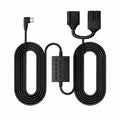
Your car's constant power is needed for a capacitor to work for a long time. It's great for cars that have dedicated hardwire kits that connect to the fuse box. The quick energy recovery makes sure that files close safely when the ignition turns off. The hardwire kit then sends a steady stream of power from your car battery to the camera so it can keep an eye on things while you shop or sleep.
Some models may have a battery that allows for short-term standalone monitoring without a hardwire kit. But the internal capacity goes down quickly over time. If you use the internal battery for this mode, especially in hot weather, it will die quickly. You still need a hardwire kit or a separate external power bank for real long-term monitoring, so the internal battery is useless.
Knowing how much care your dash cam needs over time can help it last longer. The type of battery in your camera affects how often you need to check it and how much it will cost to fix or replace it.
Supercapacitors need almost no maintenance and don't wear down much over time. You just put the camera up and forget about it. Because you can set it and forget it, it's a favorite among people who drive to work every day. The device just works, which saves you time and makes you less angry.
Lithium batteries make you keep an eye on the device for swelling and a loss of power. You often have to pay for replacements after only one or two years. If you have a battery model, don't drive in hot cars. If you often park in the sun, take the camera down and put it in the glove box to make it last longer.
Comparing both types side by side can help you figure out how much value you get for your money, how much it will cost to install, and what the upfront costs are. This way, you know what to expect when you use your dash cam in your car.
For long-term monitoring, a capacitor model usually needs a hardwire kit. You need to connect cables to your fuse box. This process takes some time and work. Some battery-powered cameras can use their internal cell to monitor things for short periods of time without needing extra wires. Even battery-powered cameras need to be hardwired or have an external power pack for long-term use, though. This requirement takes away the perceived convenience benefit of a battery model.
When you check out at the store, capacitor models cost a little bit more. But they have much lower costs for replacements over the course of five years. You only have to buy it once. At first, lithium battery models may seem less expensive. But over time, they have to pay for replacements and maintenance. When you take into account how short the battery's life is, the cheaper model ends up costing you a lot more in the long run.
You need to weigh the pros and cons for yourself. Think about where you live, how much money you have, and how important convenience is to you.
If you live in an area where summers are very hot or winters are very cold, you should choose a capacitor model. You want a device that lasts for at least five years and is very reliable. You also don't mind putting in a hardwire kit to unlock the advanced monitoring features while your car is parked.
If you live in a place where the weather is mild and temperatures don't go up very often, you should get a battery model. You want to pay less up front and only need to monitor things on their own for a short time without having to deal with messy fuse box wires. You also agree that you will need to get a new camera or battery within two years.
There are valid uses for both technologies for different drivers. The choice is entirely dependent on your local environment, daily usage habits, and long-term maintenance priorities. A capacitor is still the best choice if you want something that will last a long time and won't swell. A brand like Redtiger makes great capacitor models that can handle the hottest summer weather. Take the time to think about your climate and choose the power source that works best for you.
A capacitor is much better for hot climates and longevity. A battery costs less initially but degrades very quickly under harsh automotive heat.
Yes, they last much longer. They can function perfectly for over five years, whereas batteries typically degrade and fail within two years.
No, they rarely need replacement. They withstand thousands of charge cycles without chemical decay, which saves you money and eliminates regular maintenance hassles.
They can support it for a very short time. However, frequent use of this mode drains the battery fast and permanently ruins its total capacity.
