















Best Aperture for Dash Cam: What It Means and Why It Matters for Your Footage?
|
|
Time to read 8 min

Help Center
Get help with setup, updates, and information

Track My Order
Check Your Package Tracking Status Online

Learn About Dash Cam
The Latest Dash Cam News and Information

Redtiger Player
Play the videos you've recorded on your PC

REDTIGER CAM APP
Download the Redtiger app and use it via a Wi-Fi connection
 Channel
 Sensor
 Video Resolution
 Display
 Lens Aperture
 HDR/WDR
 Wi-Fi
Wi-Fi
 Touch Screen Control
 Voice Control
 Parking Mode
 NiteGuard ™ Parking Mode
 Night vision capability
 GPS Logger
 G-sensor
 Loop Recording
 Storage
 CPL Supported
 Mounting Type (Default)
 Battery & Charging
 Working Temperature
We provide comprehensive pre-sales and after-sales service.

Redtiger offers free shipping on orders totaling $50 or more. We recommend purchasing shipping protection to safeguard your package and money.

Redtiger offers a 30-day money-back guarantee. You may contact us for a no-questions-asked return within 30 days of receiving your order.

Ordering a dashcam through the Redtiger official website entitles you to an additional 6-month extended warranty. This brings the total warranty period to 24 months.

Redtiger provides 24/7 customer service. You can contact us via email or call our customer service hotline directly.
No need to worry about after-sales service—we provide comprehensive after-sales support.
We offer free shipping on qualifying orders with no hidden fees or surprise charges.
Most orders are processed within 1–2 business days and shipped through trusted carriers to ensure safe and timely delivery.
You’ll receive tracking details as soon as your order ships, so you can follow it every step of the way.
From checkout to delivery, we make the process simple and worry-free.

Your satisfaction comes first. If you’re not completely happy with your purchase, you can request a return within 30 days of delivery.
Simply reach out to our support team and we’ll guide you through the process.
Once your item is received and inspected, your refund will be issued promptly according to our policy.
Shop with confidence knowing your purchase is protected.

We use industry-standard encryption and trusted payment providers to protect every transaction.
Your personal and payment information is securely processed and never stored or shared without authorization.
Multiple secure payment options are available for your convenience, so you can complete your purchase with total confidence.

Have a question? We’re here to help.
Our dedicated customer support team responds quickly and provides clear, helpful solutions — whether it’s product guidance, order updates, or after-sales support.
We’re committed to delivering a smooth experience before and after your purchase.
|
|
Time to read 8 min
When shoppers compare dash cams, they tend to fixate on resolution. 4K vs 1080p, front vs dual-channel, and wide-angle vs standard. But one specification quietly determines whether your footage is actually useful at night, in tunnels, or under low-contrast conditions.
The feature barely gets mentioned: lens aperture. Understanding the best aperture for dash cam use is a practical question relevant to the quality of your video. This guide breaks down camera lens aperture, its function in real-world conditions, and the aperture number to look for.
Table of contents
Lens aperture is the opening within a camera lens. It controls how much light reaches the image sensor. Think of it like the pupil of an eye. In low light, your pupil dilates to let in more light.
A camera's aperture works the same way. A wider opening captures more light, producing brighter, clearer, and sharper images in dark conditions.
Aperture is measured in f-stops, written as f/1.8, f/2.0, f/2.8, and so on. The counterintuitive part: a smaller f-number means a wider opening. So, f/1.8 lets in significantly more light than f/2.8.
The f-stop is actually a ratio: focal length divided by aperture diameter. And a larger diameter (wider opening) produces a smaller ratio. That's why f/1.8 is "wider" than f/2.8, even though 1.8 is a smaller number.
For a quick reference:
Aperture makes the biggest difference in this case. According to NHTSA, nearly half of all fatal crashes occur at night, despite a much lower percentage of total driving miles. If your dash cam can't capture readable footage, it's not doing its most important job. A cam with an F1.8 lens aperture admits around 2.5x as much light as a cam at f/2.8.
Therefore,
You might wonder: if a wider aperture lets in more light, does that mean daytime footage gets overexposed? In a well-designed cam, no.
Quality dash cams pair a wide-angle lens with a Wide Dynamic Range (WDR) or High Dynamic Range (HDR) sensor. They automatically balance the brightness and darkness within the same frame.
WDR prevents the camera from blowing out highlights, which can lose detail in the shadows, and vice versa. The footage remains natural and readable in both sunny and shaded conditions.
In portrait photography, a wide aperture creates a blurred background (bokeh). For dash cams, that's not what you want. You need sharp details, from the front bumpers ahead to the distant road signs.
Fortunately, dash cam lenses include a fixed focus and a focal length to keep most of the road scene sharp. The depth of field is enough to discard bokeh as a concern. You get the low-light benefits of a wide aperture without sacrificing the sharpness you need.
F1.8 is the ideal aperture for dash cam use. This is where the performance-to-cost ratio peaks for the category.
Going wider than f/1.8 (such as f/1.4) is technically possible. However, it adds high cost and manufacturing complexity for marginal real-world gains.
Budget dash cams often ship with f/2.8 lenses because narrower apertures are cheaper. In daylight, the difference is minimal. But as soon as the sun goes down, you’ll notice the obvious issues.
A great camera lens aperture is essential, but it works as part of the system. Let's look at the other factors that determine overall image quality.
The sensor converts light captured through the lens aperture into a digital image. A larger sensor captures more light per pixel, reducing noise. High-quality sensors, like the Sony Starvis IMX series, can handle low-light conditions.
A combination of an F1.8 lens and a Sony Starvis IMX sensor significantly improves nighttime footage. Interestingly, neither component can achieve something like that alone.
As mentioned, WDR and HDR processing keep a wide-aperture cam from blowing out highlights. These features are especially important to serve several purposes.
The physical quality of the lens glass matters too. Multi-layer anti-reflective coatings reduce lens flare and ghosting for driving toward bright lights at night.
A six-element or seven-element glass lens produces sharper, more accurate colors than a basic plastic lens. Look for manufacturers who specify glass elements rather than plastic optics.
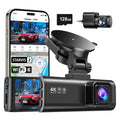
The Redtiger ViewClear 70 features an F1.8 aperture on both the front and rear cameras. Notably, many dual-channel dash cams cut corners on the rear cam. With matching F1.8 lenses on both channels, the ViewClear 70 delivers consistent low-light performance from every angle.
It matters most in hit-and-run incidents in parking lots and in rear-end collisions in dark conditions. The same goes for monitoring pedestrians or cyclists approaching from behind at night.
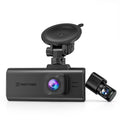
The Redtiger F77 combines an F1.8 aperture with front and rear dual 4K recording, delivering sharp footage from both directions. The wide F1.8 aperture allows more light to reach the sensor, helping maintain image clarity in dim environments such as night driving, parking lots, and poorly lit streets.
Paired with dual 4K resolution, the F77 captures finer details like license plates, road signs, and surrounding traffic from both the front and rear cameras. This combination helps produce clearer, more usable footage when lighting conditions are less than ideal.
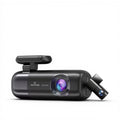
The Redtiger F17 Elite pairs an F1.8 aperture with 3-channel color night vision, helping capture clearer footage from the front, rear, and cabin even after dark. The wide F1.8 aperture allows more light to reach the sensor, improving brightness and reducing image noise in challenging lighting conditions.
Combined with color night vision technology, the F17 Elite preserves more visual detail and natural colors at night, making it easier to identify vehicles, road signs, and activity around the car. For drivers who frequently drive after sunset or use their vehicle for rideshare work, this combination provides stronger visibility when it matters most.
It's one of the most common questions people ask when shopping for a dash cam. The short answer: aperture matters more in low light; resolution matters more in good light.
In daylight, even a cam with an f/2.8 lens captures plenty of light. At that point, resolution becomes the dominant factor for detail. A 4K cam at f/2.8 will capture a license plate across four lanes of traffic more reliably than a 1080p cam at f/1.8.
At night or in low-light conditions, resolution is nearly meaningless if the lens can't gather enough light. A 4K cam at f/2.8 in a dark parking lot often produces 4K noise – 4x times the pixels of unreadable footage. A 1080p cam at f/1.8 in the same conditions will deliver far cleaner footage.
The ideal combination remains balancing both. Get high resolution and a wide, best-in-class aperture for a dash cam like f/1.8. That's exactly what Redtiger's F77 delivers with its dual 4K recording and F1.8 lens.
Most people researching dash cams spend a lot of time on resolution, brand names, and price. Lens aperture often gets skipped over as an honest mistake. It's not the case when that spec determines whether your cam delivers usable footage when lighting isn't ideal.
The best aperture for dash cam use is F1.8. It lets in significantly more light than narrower options. And Redtiger dash cams: ViewClear 70, the F77, and the F17 Elite. Builds F1.8 into every camera as standard. If you want reliable footage day and night, explore the full Redtiger range.
Not for a well-designed dash cam. Dash cams use fixed-focus lenses optimized to keep everything from a few meters ahead to the horizon sharp. F1.8 on a dash cam simply lets in more light for the same sharp, front-to-back focus.
Fixed. Dash cam lenses have a single, fixed-aperture lens. Whatever f-stop is listed in the specs is what you get in all conditions. That's why the f-stop you see on a spec sheet matters so much.
Yes. Check the product page, the packaging, or the user manual. It will be listed under lens specifications as "aperture," "f-stop," or simply as "F1.8" or a similar value. If you can't find it, that's often a red flag.
No. Aperture is a purely mechanical property of the lens. It marks a physical opening, not an electronic component. A wider aperture doesn't consume more power. Battery usage is split among the processor, sensor, screen, and wireless features.

