



















Benefits of Dash Cams with GPS Tracking: Why USA Drivers Need Them?
|
|
Time to read 9 min

Help Center
Get help with setup, updates, and information

Track My Order
Check Your Package Tracking Status Online

Learn About Dash Cam
The Latest Dash Cam News and Information

Redtiger Player
Play the videos you've recorded on your PC

REDTIGER CAM APP
Download the Redtiger app and use it via a Wi-Fi connection
 Channel
 Sensor
 Video Resolution
 Display
 Lens Aperture
 HDR/WDR
 Wi-Fi
Wi-Fi
 Touch Screen Control
 Voice Control
 Parking Mode
 NiteGuard ™ Parking Mode
 Night vision capability
 GPS Logger
 G-sensor
 Loop Recording
 Storage
 CPL Supported
 Mounting Type (Default)
 Battery & Charging
 Working Temperature
We provide comprehensive pre-sales and after-sales service.

Redtiger offers free shipping on orders totaling $50 or more. We recommend purchasing shipping protection to safeguard your package and money.

Redtiger offers a 30-day money-back guarantee. You may contact us for a no-questions-asked return within 30 days of receiving your order.

Ordering a dashcam through the Redtiger official website entitles you to an additional 6-month extended warranty. This brings the total warranty period to 24 months.

Redtiger provides 24/7 customer service. You can contact us via email or call our customer service hotline directly.
No need to worry about after-sales service—we provide comprehensive after-sales support.
We offer free shipping on qualifying orders with no hidden fees or surprise charges.
Most orders are processed within 1–2 business days and shipped through trusted carriers to ensure safe and timely delivery.
You’ll receive tracking details as soon as your order ships, so you can follow it every step of the way.
From checkout to delivery, we make the process simple and worry-free.

Your satisfaction comes first. If you’re not completely happy with your purchase, you can request a return within 30 days of delivery.
Simply reach out to our support team and we’ll guide you through the process.
Once your item is received and inspected, your refund will be issued promptly according to our policy.
Shop with confidence knowing your purchase is protected.

We use industry-standard encryption and trusted payment providers to protect every transaction.
Your personal and payment information is securely processed and never stored or shared without authorization.
Multiple secure payment options are available for your convenience, so you can complete your purchase with total confidence.

Have a question? We’re here to help.
Our dedicated customer support team responds quickly and provides clear, helpful solutions — whether it’s product guidance, order updates, or after-sales support.
We’re committed to delivering a smooth experience before and after your purchase.
|
|
Time to read 9 min
A dash cam records what happens in front of your vehicle. A dash cam with GPS tracking records what happened, where it happened, how fast you were going, and the exact route you traveled to get there.
US drivers deal with insurance disputes, hit-and-run incidents, teen drivers, and/or fleet management. And that additional layer eventually makes the difference between a quickly resolving claim and a dragging one.
The recognized benefits of dash cams with GPS tracking for USA drivers are increasing. This guide breaks down every great advantage and shows exactly which Redtiger models deliver them most effectively.
Table of contents
You should understand what GPS tracking in a dash cam actually records. And it does way more than showing a simple dot on a map.
A GPS-enabled dash cam logs the vehicle's precise latitude and longitude with every frame of footage. Any clip involving a collision, near-miss, or routine commute carries an exact location stamp.
Location data travels with the clip when sharing the footage with an insurer, law enforcement, or an attorney. The embedded metadata can't be altered, giving it real evidentiary weight in disputes.
Speed is the most contested variable in almost every collision claim. How fast was the vehicle traveling? Was it exceeding the speed limit? Was the driver slowing or accelerating at the moment of impact?
A dash cam with GPS records speed in real time, giving an objective answer to all of those questions. Liability disputes in multi-car accidents are common in California, Texas, and Florida.
Having documented speed data from a GPS dash cam can shift a disputed liability outcome entirely. Insurers always respond differently to "I was going the speed limit," backed by GPS-logged speed data.
Read more: Dash Cam That Records Speed
A GPS tracking dash cam logs where the incident happened, plus the full route the vehicle traveled. It's particularly valuable in hit-and-run scenarios and where the exact location of an accident is disputed.
Route history is also exportable in most quality dash cams with GPS tracking, like Redtiger dash cams. You can share it directly with law enforcement or present it as a supporting document in legal proceedings.
We've established the data capabilities. Now, it's time to know how they translate into real-world advantages for everyday drivers, rideshare operators, families, and fleet managers across the US.
The single most-cited benefit of dash cams with GPS tracking is their impact on insurance claims. A video clip with GPS coordinates, timestamped speed, and a verified route is substantially more compelling.
Insurance adjusters look for inconsistencies between driver accounts and available evidence. A GPS-enabled dash cam eliminates most of the ambiguity that creates those inconsistencies.
The Insurance Information Institute noted that dashcam-supported claims are processed more quickly. It even results in fewer disputed liability decisions than claims based solely on driver testimony.
US drivers have to pay an average annual premium of $2,000 or even more in many cases. With GPS, the ability to resolve a single at-fault dispute outweighs the cost of the device by a wide margin.
According to the AAA Foundation for Traffic Safety, one in six US accidents involves a driver who leaves the scene. Without a dash cam, a hit-and-run is nearly unsolvable for the victim: no plate, no description, no evidence.
With a dash cam with GPS tracking, the footage captures the plate, the angle of impact, and the direction the vehicle fled. The GPS data confirms your vehicle's position, enabling you to pull camera footage from the exact location.
The combination of video and location data has significantly improved the overall hit-and-run resolution rate across jurisdictions. Police departments have started training officers to incorporate dashcam GPS data into their initial reports.
Parents who hand the keys to a new driver are handing over a significant responsibility. A GPS tracking dash cam gives parents an objective record of how that responsibility is being handled.
It eliminates the traditional surveillance-style live tracking. Instead, it introduces reviewable footage and speed data that reflect actual driving behavior. When a teen driver exceeds the speed limit, the GPS log reflects it.
If they took a route that wasn't in the plan, the route history shows it. For most families, it's about having a safety tool that creates accountability without requiring a passenger to be present.
Many small business owners operate two or three commercial vehicles. And a GPS dash cam transforms what's visible about those vehicles. Fleet management with GPS lets owners review the routes, identify idling, confirm delivery, and monitor behavior.
And they have real dollar value. Insurance premiums for commercial vehicles with documented GPS dash cam systems are lower at many carriers. It's because the devices reduce claim frequency and severity.
Driver behavior tends to improve when operators know the vehicle comes with a GPS tracking dash cam. It's not because of surveillance. But objective accountability is a proven motivator for professional behavior behind the wheel.
A dash cam can assist with stolen vehicle recovery, but only if it supports remote monitoring and cloud storage. Standard GPS-enabled dash cams record location data and embed GPS coordinates into video files, but they cannot actively track a stolen vehicle once it leaves your possession.
Dash cams with remote connectivity allow owners to access footage and location information through a mobile app, while cloud storage helps preserve critical evidence even if the camera is damaged or removed from the vehicle.
For an LTE dash cam equipped with parking mode, remote monitoring, cloud storage, and GPS logging, the system may capture footage of the theft and provide location information that can help law enforcement investigate the incident. GPS-stamped video evidence combined with cloud-saved recordings can significantly improve the chances of identifying what happened and where the vehicle was last located.
Advanced driver assistance systems (ADAS) include lane departure warnings, forward collision alerts, and driver fatigue warnings. These features can work more effectively when combined with GPS speed data.
GPS allows the system to understand the vehicle's driving context, such as whether it is traveling on a highway or in urban traffic. This speed information can help the ADAS algorithm adjust its sensitivity and improve situational awareness.
The Redtiger F7NA integrates ADAS with GPS-enabled recording. This combination provides contextual driving data that can help refine alert timing and reduce unnecessary warnings in certain driving conditions.
Red-light disputes, yield violations, and lane-change accidents are among the most commonly contested traffic incidents in the US. And driver accounts are almost always contradictory in such situations.
Each party claims the other was at fault, and without decisive evidence, liability determination comes down to judgment calls. A GPS dash cam provides the independent evidence layer. And it shifts disputes from "he said, she said" to "here's what the data shows" real fast.
GPS-stamped location, speed at the time, and video from multiple angles establish the full scenario. Attorneys and insurers consider it reliable proof, particularly with a front- and rear-facing dash cam with GPS.
Feature |
Without GPS |
With GPS Tracking |
Incident Location Data |
No |
Yes (exact coordinates logged) |
Speed at Time of Event |
No |
Yes (recorded alongside footage) |
Route History |
No |
Yes (exportable log) |
Insurance Dispute Value |
Video only |
Video + location + speed data |
Fleet Accountability |
Limited |
Full (driver behavior visible) |
Stolen Vehicle Recovery |
None |
Last known GPS location on file |
ADAS Integration |
No |
Yes (speed-linked alerts possible) |
Each row represents a real-world scenario in which GPS data closes an evidentiary gap. The difference is particularly stark in the insurance, fleet, and recovery rows.
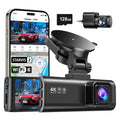
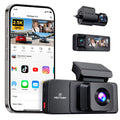
The F7NA is a 4K front and rear dash cam built around the Sony Starvis 2 sensor. It delivers superb low-light performance for the GPS-enabled recording. The Redtiger F7NA integrates ADAS features to make the alerts context-aware.
The model provides a complete package for daily commuters, rideshare drivers, and anyone who logs significant highway miles. The GPS track data remains available for review in the companion app alongside the footage.
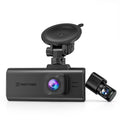
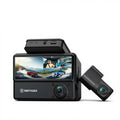
The 3-channel dash cam features 4K front recording, a 2.5K rear camera, and a 1080p full-color night-vision interior camera. And they all run simultaneously with GPS tracking active. The F17 Elite provides the most coverage for rideshare drivers who need documentation of the road and the cabin.
The GPS data layer is especially valuable for rideshare operators: it logs the exact route taken on every trip. The Wi-Fi 6 connectivity makes it fast and easy to pull footage or GPS logs from the camera via the app between rides without needing to remove the microSD card.
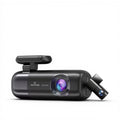
The VisionPano 40 is a 4-channel dash cam that covers the front, left, right, and rear. Its dual Sony Starvis 2 sensors, 5.8 GHz Wi-Fi, and GPS remain active across all recording channels simultaneously.
It's the most complete solution for commercial drivers, fleet vehicles, and anyone who needs near-360° documentation with GPS-stamped location.
The side cameras close the blind spot coverage gap, particularly valuable in lane-change disputes and side-impact claims. The VisionPano 40 provides both, making it a strong choice for fleet management.
Look for a device that specifies its GPS chipset or references a well-known GPS platform in its specs. A fast update rate, 10 Hz or higher, means the speed data is accurate during rapid velocity changes.
Highway driving, varied weather, and nighttime incidents are all common in the US. 4K front resolution and a Sony Starvis 2 or equivalent sensor are the right baseline for any serious GPS-enabled dash cam purchase.
The GPS logs from a dash cam are only useful if you can access them easily. Redtiger's companion app displays GPS track data on a map alongside the corresponding footage, keeping it simple and steady.
A GPS dash cam with active parking mode retains location data even while the vehicle is stationary. It's the feature that makes stolen vehicle recovery simple, as it logs the last known location of the vehicle when it was moved.
The benefits of dash cams with GPS go well beyond what a standard camera can offer to US drivers. Location data, speed logging, route history, and ADAS integration transform a passive recording into a safety + documentation tool.
You'll have the upper hand in insurance disputes, hit-and-run incidents, fleet operations, and legal proceedings. And Redtiger builds GPS tracking into most capable models to let you get the most out of the benefits.
The F7NA serves daily drivers who want ADAS + GPS, whereas the F17 Elite seems great for rideshare operators. Meanwhile, the VisionPano 40 seems perfect for drivers who want four-channel coverage with GPS stamping on every angle.
There are several great benefits of having a dash cam with GPS. But the top one, backed by fact and valuation, is stronger insurance claim documentation with location and speed data for any incident.
No. GPS tracking runs on a separate module from the camera sensor and recording processor. It adds data to the clip metadata without consuming processing resources that affect video quality.
Yes. Insurance adjusters are familiar with GPS-stamped dash cam footage as a documentation format. The GPS log establishes location, speed, and route in a verifiable format. An adjuster software can cross-reference against traffic records and map data.
No. Redtiger's GPS tracking functions without a subscription or any ongoing fees. The GPS module receives satellite signals directly and logs data to the microSD card alongside the footage.
The Redtiger VisionPano 40 is the best choice for fleet management. Its 4-channel coverage, front, left, right, and rear, with GPS tracking active on all channels, provides complete documentation.

