















Action Camera vs Dash Cam: Uncover the Perfect Choice for You
|
|
Time to read 9 min

Help Center
Get help with setup, updates, and information

Track My Order
Check Your Package Tracking Status Online

Learn About Dash Cam
The Latest Dash Cam News and Information

Redtiger Player
Play the videos you've recorded on your PC

REDTIGER CAM APP
Download the Redtiger app and use it via a Wi-Fi connection
 Channel
 Sensor
 Video Resolution
 Display
 Lens Aperture
 HDR/WDR
 Wi-Fi
Wi-Fi
 Touch Screen Control
 Voice Control
 Parking Mode
 NiteGuard ™ Parking Mode
 Night vision capability
 GPS Logger
 G-sensor
 Loop Recording
 Storage
 CPL Supported
 Mounting Type (Default)
 Battery & Charging
 Working Temperature
We provide comprehensive pre-sales and after-sales service.

Redtiger offers free shipping on orders totaling $50 or more. We recommend purchasing shipping protection to safeguard your package and money.

Redtiger offers a 30-day money-back guarantee. You may contact us for a no-questions-asked return within 30 days of receiving your order.

Ordering a dashcam through the Redtiger official website entitles you to an additional 6-month extended warranty. This brings the total warranty period to 24 months.

Redtiger provides 24/7 customer service. You can contact us via email or call our customer service hotline directly.
No need to worry about after-sales service—we provide comprehensive after-sales support.
We offer free shipping on qualifying orders with no hidden fees or surprise charges.
Most orders are processed within 1–2 business days and shipped through trusted carriers to ensure safe and timely delivery.
You’ll receive tracking details as soon as your order ships, so you can follow it every step of the way.
From checkout to delivery, we make the process simple and worry-free.

Your satisfaction comes first. If you’re not completely happy with your purchase, you can request a return within 30 days of delivery.
Simply reach out to our support team and we’ll guide you through the process.
Once your item is received and inspected, your refund will be issued promptly according to our policy.
Shop with confidence knowing your purchase is protected.

We use industry-standard encryption and trusted payment providers to protect every transaction.
Your personal and payment information is securely processed and never stored or shared without authorization.
Multiple secure payment options are available for your convenience, so you can complete your purchase with total confidence.

Have a question? We’re here to help.
Our dedicated customer support team responds quickly and provides clear, helpful solutions — whether it’s product guidance, order updates, or after-sales support.
We’re committed to delivering a smooth experience before and after your purchase.
|
|
Time to read 9 min
It can be hard to pick the right camera for your car. What kind of camera do you need to record your drives? Many drivers wonder, "Can I use an action camera as a dash cam?"
In this guide, we break down the key differences between an action camera vs dash cam, helping you understand which one is best for everyday driving, safety, and capturing road moments.
A small, tough camera made for adventure is called an action camera. You can put it up almost anywhere to record fun times.
An action camera is the best way to record exciting events. Think of it as a camera for sports, travel, and fun in the great outdoors. The main thing it does is record high-quality video of fast-moving action. People use them for a lot of things, like surfing and mountain biking.
People know that these cameras take great videos. They often record in high resolutions like 4K, which makes the footage clear and detailed. This makes your videos of adventures look clear and professional. You can put an action camera on your helmet, handlebars, chest, or even the dashboard of your car.
There are many reasons why action cameras are so popular. Because they are small and light, you can easily take them anywhere. You don't have to worry about them while you're out having fun because they are made to handle tough conditions. The video quality is usually very good, with high resolutions and frame rates that make slow-motion playback smooth.
But action cameras have some problems, especially for driving every day. You might have to charge them often because their batteries don't last very long. They also don't have automatic features that other cameras do.
A dash cam is a vehicle-mounted camera designed to automatically record the road and in-car activity while you drive, providing continuous footage for security, evidence, and peace of mind.
The main purpose of a dash cam is to record your drives without making any noise. It records the road all the time while you drive. It is not for taking pictures of your own adventures like other cameras. It is a device for security. It is there to keep track of everything from your daily commute to accidents that happen on the road.
Dash cams are all about making things automatic. They work without you having to do anything. When you start your car, most dash cams turn on and start recording right away. They also have the ability to record in loops. This means that the camera will automatically erase the oldest footage when the memory card is full. You never have to worry about not having enough room.
The best thing about a dash cam is that it works on its own. You set it up, and it runs by itself. With the loop recording feature, you always have the most recent footage without having to delete anything from the memory card. A lot of models also have a G-sensor. This sensor picks up impacts and automatically saves and locks the video file that goes with them.
While dash cams are designed specifically for use in vehicles, their functionality is limited to driving and in-car recording. They are meant to stay mounted in your car and capture what happens on the road or inside the cabin.
A dash cam can record moments from a family road trip, such as scenic drives or conversations in the car. However, it isn't portable and can't be used once you leave the vehicle.
Most dash cams also require a constant power supply from the car, making them ideal for continuous driving footage but impractical for recording activities outside the vehicle.
Even though these two devices look a lot alike, they are very different in what they do.
One big difference is how each camera gets power and works.
Your dash cam was made for your car. It connects to the power source of your car and turns on and off with the key. You don't have to think about it; it just works.
You have to turn an action camera on and off by hand. It has its own battery, which usually lasts for only one or two hours. You would have to remember to charge it and hit the record button every time you went somewhere.
Dash cams are made to record all the time. They use something called loop recording. This means that when your memory card is full, the camera will automatically delete the oldest files to make room for new ones. You never miss a moment because your card is full.
But an action camera stops recording when its memory is full. To keep recording, you need to delete old files by hand. This is a big problem if you want to use an action camera as a dash cam because you might not record a very important event.
Many dash cams have built-in sensors that let them record more than just video. A G-sensor picks up sudden impacts, like a crash, and locks the video file so it can't be overwritten. GPS keeps track of where your car is and how fast it's going. This information is important in case of an accident.
These sensors are not usually found in action cameras. Some people may have GPS to help them find their way on an adventure, but they don't have the impact detection that is so important for proving what happened in a car accident.
The main difference is how they are meant to be used. A dash cam is a safety feature for cars. The heat-resistant build and automatic recording features are just two examples of how this product is made to be used in a car. It is a reliable witness on the road.
A lifestyle device is an action camera. It is made to record high-quality, moving footage of your travels and hobbies. It can record video from a car, but it doesn't have the automated, specialized features that make a dash cam a safe tool for everyday driving.
Feature |
Dash Cam |
Action Camera |
Power & Automation |
Car-powered; auto on/off |
Battery-powered; manual |
Continuous Recording |
Loop recording; no gaps |
Stops when memory full |
Impact Detection |
G-sensor; locks collision footage |
Usually none |
GPS Tracking |
Yes; records location & speed |
Usually none |
Video Quality |
High (up to 4K) |
High (up to 4K) |
Mounting |
Fixed in-car |
Flexible, creative angles |
Hands-Free Operation |
Voice control |
Manual control |
Best Use |
Driving safety, accidents, parked cars |
Sports, travel, vlogging |
While an action camera can record high-quality, wide-angle footage in your car, it isn't designed for continuous, hands-free operation like a dash cam, making it less practical for everyday driving safety.
You can definitely get good video from your car with an action camera. The wide-angle lens lets you see the whole road ahead. The high-resolution video can make clear and detailed footage, which is useful. You can attach it to your dashboard or windshield and record your trip.
There are serious practical limits to using an action camera as a dash cam for everyday safety. You need to remember to turn it on and off for each trip. If you don't keep it plugged in, the battery will probably die on long trips. Most action cameras aren't made to run all the time and can get too hot.
For a deeper look at using GoPro as a Dash Cam and why it may not be the best choice for your car, check out our detailed guide.
A purpose-built dash cam shines in real-world driving situations because it works seamlessly with your car and your daily routine.
Whether you're commuting, running errands, or on a road trip, your dash cam automatically starts and stops with the engine, so you never miss a moment.
Continuous loop recording ensures that your most recent drives are always captured, without you having to manage memory cards.
In the event of a collision or sudden stop, the G-sensor locks crucial footage, giving you peace of mind and solid evidence when you need it.
With parking mode, your dash cam provides 24-hour surveillance while your car is unattended, automatically detecting collisions or any attempts to tamper with the vehicle and locking the crucial video footage for evidence.
Many modern dash cams allow you to use simple voice commands. You can save a video, take a photo or turn audio recording on or off without taking your hands off the wheel.
Wi-Fi connectivity lets you instantly view, download, or share clips with friends, insurance companies, or authorities, all without removing the memory card.
In the U.S., dash cams aren't just a nice‑to‑have accessory — they're increasingly common tools for drivers. According to a recent study, about 30% of American drivers (around 69 million people) already use dash cams, and 40% of those users have captured a crash or traffic incident on video, with roughly half using that footage in an insurance claim.
Because dash cams provide clear, unbiased video evidence of what really happened on the road, they can simplify fault determination, help deter staged accidents, and reduce costly disputes in insurance claims. In fleet studies, vehicles with dash cams saw up to 55% lower payouts in third‑party hit claims thanks to video evidence, demonstrating the real financial and legal value of having reliable in-car recording.
Even though a dash cam is better for safety, an action camera can still play a valuable role in your vehicle.
An action camera is perfect for capturing the beauty of a scenic drive. You can record your entire journey through the mountains or along the coast in high-quality video.
If you participate in track days or off-road events, an action camera is great for capturing the action from exciting angles inside and outside your vehicle.
You can use an action camera alongside your dash cam. It can record a different view like the interior of the car or a rear-facing angle, for more creative footage.
For content creators and vloggers, an action camera is a versatile tool. You can easily remove it from the car to film other parts of your trip or vlog.
When it comes to protecting yourself on the road, the choice is clear. The debate over an action camera vs dash cam ends with purpose. An action camera is excellent for capturing adventures in stunning detail, but it falls short for automatic, reliable, and continuous vehicle recording. For drivers who want a set-and-forget solution, dash cams from a trustworthy brand like Redtiger provide the performance and peace of mind needed for everyday driving safety.
A dash cam automatically records your drives for safety. An action camera manually records activities like sports and travel with high-quality video and versatile mounts.
Action cameras have short battery life, require manual operation and lack automatic features like loop recording and impact detection which are important for driving.
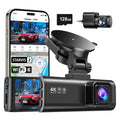
Yes, modern dash cams like the REDTIGER F17 Elite can record in 4K resolution, delivering clear and detailed footage that rivals many action cameras while providing the reliability and automatic features of a purpose-built dash cam.
