



What Should You Look for in a Dash Cam for Nighttime Protection?
|
Time to read 6 min
 Channel
 Sensor
 Video Resolution
 Display
 Lens Aperture
 HDR/WDR
 Wi-Fi
Wi-Fi
 Touch Screen Control
 Voice Control
 Parking Mode
 NiteGuard ™ Parking Mode
 Night vision capability
 GPS Logger
 G-sensor
 Loop Recording
 Storage
 CPL Supported
 Mounting Type (Default)
 Battery & Charging
 Working Temperature
We provide comprehensive pre-sales and after-sales service.

Redtiger offers free shipping on orders totaling $50 or more. We recommend purchasing shipping protection to safeguard your package and money.

Redtiger offers a 30-day money-back guarantee. You may contact us for a no-questions-asked return within 30 days of receiving your order.

Ordering a dashcam through the Redtiger official website entitles you to an additional 6-month extended warranty. This brings the total warranty period to 24 months.

Redtiger provides 24/7 customer service. You can contact us via email or call our customer service hotline directly.
No need to worry about after-sales service—we provide comprehensive after-sales support.
We offer free shipping on qualifying orders with no hidden fees or surprise charges.
Most orders are processed within 1–2 business days and shipped through trusted carriers to ensure safe and timely delivery.
You’ll receive tracking details as soon as your order ships, so you can follow it every step of the way.
From checkout to delivery, we make the process simple and worry-free.

Your satisfaction comes first. If you’re not completely happy with your purchase, you can request a return within 30 days of delivery.
Simply reach out to our support team and we’ll guide you through the process.
Once your item is received and inspected, your refund will be issued promptly according to our policy.
Shop with confidence knowing your purchase is protected.

We use industry-standard encryption and trusted payment providers to protect every transaction.
Your personal and payment information is securely processed and never stored or shared without authorization.
Multiple secure payment options are available for your convenience, so you can complete your purchase with total confidence.

Have a question? We’re here to help.
Our dedicated customer support team responds quickly and provides clear, helpful solutions — whether it’s product guidance, order updates, or after-sales support.
We’re committed to delivering a smooth experience before and after your purchase.
|
Time to read 6 min
Although only about 25–30% of total vehicle miles are driven at night, nighttime driving accounts for about 50% of all road traffic fatalities. Nighttime driving presents unique challenges for safety and security. Reduced visibility, glare from oncoming headlights, and poorly lit streets can all compromise the quality of video evidence when you need it most. If you're shopping for a dash cam that'll deliver reliable protection around the clock, especially after dark, the right combination of hardware and software features is essential.
This guide breaks down the essential factors to consider when selecting a dash cam for nighttime protection, with practical insights and a recommended product that delivers reliable performance after dark. Take the ViewClear 70 as an example: under strict testing conditions (5-lux street-light scene, at native 2K 30fps with HDR on), it captured an impressive 90% of license plates clearly at a distance of 7 meters. Read on to find the perfect night vision solution for your safety.
Table of contents
Standard dash cams may record acceptable daytime footage, but poor low-light performance can render night recordings useless when you need them most. Choosing a night vision dash cam for night driving means the camera should:
These capabilities depend largely on hardware quality (sensor and optics) and image processing, not just resolution numbers.
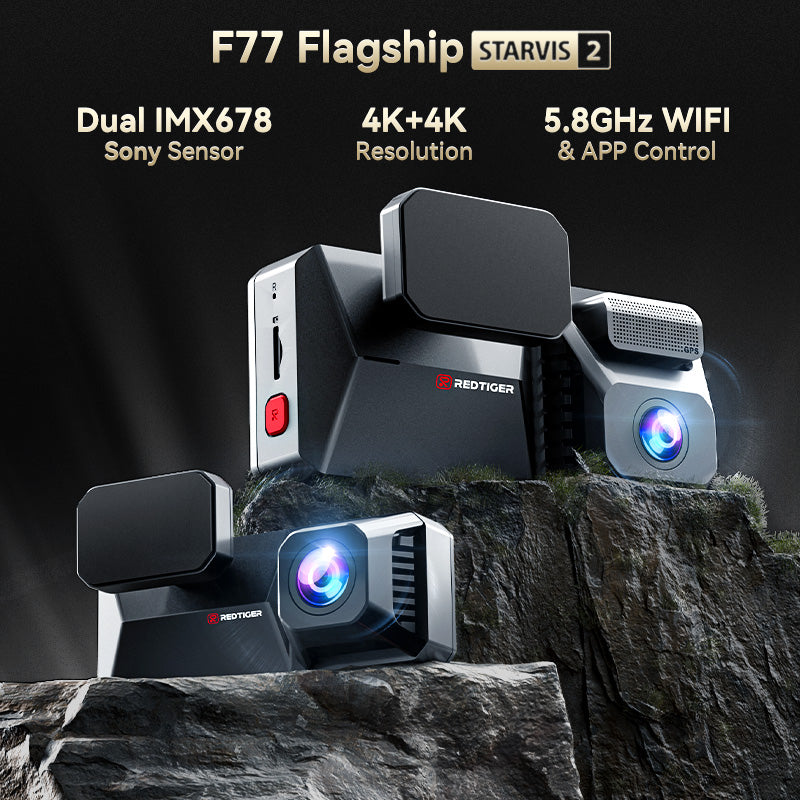
A dash cam's image sensor determines how much light it can capture. The Sony STARVIS 2 IMX678 sensor plays a critical role in improving dash cam night-time performance because it is specifically engineered for low-light imaging. Compared with conventional image sensors, STARVIS 2 technology significantly increases light sensitivity, allowing the camera to capture more detail in dark environments without relying on excessive digital gain. This results in brighter, cleaner footage with less noise and better color accuracy at night.
HDR (High Dynamic Range) is especially important for dash cams used at night because nighttime driving presents extreme lighting contrasts that standard cameras struggle to handle. On dark roads, a single frame often contains very bright elements—such as oncoming headlights, streetlights, or illuminated signs—alongside very dark areas like unlit lanes or roadside details. Without HDR, bright areas tend to become overexposed while darker areas lose critical information.
HDR technology solves this by combining multiple exposures into one balanced image, preserving detail in both highlights and shadows. As a result, license plates remain readable, vehicles and pedestrians are more clearly defined, and sudden light changes are handled smoothly. For night driving, HDR is not just a visual enhancement—it directly improves the reliability and evidentiary value of recorded footage.
In the United States, insurer data shows that about 69% of hit-and-run collisions involve a parked (unattended) vehicle, indicating that a large share of these incidents happen when the vehicle is not being actively driven. In dark parking lots or on poorly lit streets, standard cameras often fail to capture clear details such as faces, license plates, or the exact sequence of events.
A night vision dash cam equipped with advanced night vision technology can amplify ambient light, reduce image noise, and maintain balanced exposure, ensuring that crucial details remain visible even in near-dark conditions. When combined with an intelligent parking monitor mode that activates automatically upon impact or motion, superior night vision transforms the dash cam into a reliable, around-the-clock witness—providing clear, actionable evidence in cases of hit-and-run, vandalism, or suspicious activity.
Source: Report: 69% of hit-and-run collisions involve parked vehicles
Beyond imaging clarity and resolution, consider these supporting capabilities:
Redtiger ViewClear 70 stands out as a compelling choice for nighttime protection due to its balanced combination of features and performance:
Other Dash Cam Rear Camera Performance
ViewClear 70 Rear Camera Performance
Redtiger ViewClear 70 Dash Cam for Nighttime Protection
When choosing a dash cam for nighttime protection, prioritize:
The Redtiger ViewClear 70 Dash Cam checks these boxes and more—delivering enhanced night clarity and 24/7 protection whether you're driving or parked.
Protect your vehicle day and night with smart imaging technology tailored for real-world conditions. For more information, please view:
Redtiger ViewClear 70 Dash Cam
Yes. The Redtiger ViewClear 70 supports audio recording through its built-in microphone. Audio recording can be enabled or disabled in the settings, giving users flexibility based on personal preference or local regulations.
Yes. The front camera lens is adjustable up to 15°, allowing drivers to fine-tune the viewing angle for optimal road coverage and accurate alignment with their vehicle.
The ViewClear 70 supports a maximum capacity of 512GB. A 128GB SD card will be included in the package for free. To ensure optimal performance, please use a High-Endurance (High Durability) microSD card with a speed rating of U3 or V30 and above. Additionally, we recommend formatting the memory card regularly to maintain normal operation.
Yes. The ViewClear 70 supports OTA firmware upgrades via the mobile app. This allows users to receive feature enhancements, performance optimizations, and system updates conveniently without removing the device.
ViewClear 70 supports two types of Parking Monitor Mode, including:
The ViewClear 70 supports multiple loop recording functions, including:
1.Standard Loop Recording: overwrites the oldest unlocked files automatically.
2.G-Sensor Emergency Recording: locks and protects footage when sudden impacts or collisions are detected.
3.Parking Mode Loop Recording: continuous recording during parking monitoring without manual intervention.

