


















A Guide to Dash Cam and SD Card Prices: What's Happening in 2026?
|
|
Time to read 6 min

Help Center
Get help with setup, updates, and information

Track My Order
Check Your Package Tracking Status Online

Learn About Dash Cam
The Latest Dash Cam News and Information

Redtiger Player
Play the videos you've recorded on your PC

REDTIGER CAM APP
Download the Redtiger app and use it via a Wi-Fi connection
 Channel
 Sensor
 Video Resolution
 Display
 Lens Aperture
 HDR/WDR
 Wi-Fi
Wi-Fi
 Touch Screen Control
 Voice Control
 Parking Mode
 NiteGuard ™ Parking Mode
 Night vision capability
 GPS Logger
 G-sensor
 Loop Recording
 Storage
 CPL Supported
 Mounting Type (Default)
 Battery & Charging
 Working Temperature
We provide comprehensive pre-sales and after-sales service.

Redtiger offers free shipping on orders totaling $50 or more. We recommend purchasing shipping protection to safeguard your package and money.

Redtiger offers a 30-day money-back guarantee. You may contact us for a no-questions-asked return within 30 days of receiving your order.

Ordering a dashcam through the Redtiger official website entitles you to an additional 6-month extended warranty. This brings the total warranty period to 24 months.

Redtiger provides 24/7 customer service. You can contact us via email or call our customer service hotline directly.
No need to worry about after-sales service—we provide comprehensive after-sales support.
We offer free shipping on qualifying orders with no hidden fees or surprise charges.
Most orders are processed within 1–2 business days and shipped through trusted carriers to ensure safe and timely delivery.
You’ll receive tracking details as soon as your order ships, so you can follow it every step of the way.
From checkout to delivery, we make the process simple and worry-free.

Your satisfaction comes first. If you’re not completely happy with your purchase, you can request a return within 30 days of delivery.
Simply reach out to our support team and we’ll guide you through the process.
Once your item is received and inspected, your refund will be issued promptly according to our policy.
Shop with confidence knowing your purchase is protected.

We use industry-standard encryption and trusted payment providers to protect every transaction.
Your personal and payment information is securely processed and never stored or shared without authorization.
Multiple secure payment options are available for your convenience, so you can complete your purchase with total confidence.

Have a question? We’re here to help.
Our dedicated customer support team responds quickly and provides clear, helpful solutions — whether it’s product guidance, order updates, or after-sales support.
We’re committed to delivering a smooth experience before and after your purchase.
|
|
Time to read 6 min
You might have heard about changes with your dash cam and SD card prices. In 2026, many technology products cost more than before. These higher prices come from the cost of storage and memory. This means products like your SD card and dash cam could be more expensive soon.
You may wonder what storage chips are and why they matter to your dash cam. Storage chips are tiny parts that hold your videos and important files. They help your dash cam store and find video when you need it.
NAND flash chips sit inside your microSD cards. Think of them as the spot where your dash cam saves all your road videos. When you search for sd cards for dash cam, you want a card that uses strong NAND. Good quality NAND means your card will last longer and give better results.
DRAM is another kind of chip. It acts as your dash cam's helper for quick work. Your dash cam uses DRAM to make sure your video is smooth before saving it to your dash cam sd card. If your dash cam has more DRAM, it can work more quickly and not slow down when recording. Redtiger dash cams use these parts to boost your camera's performance.
Many people want to know why these chips now cost more. The answer is not one thing, but many at once. Global markets, supply and new tech trends have reasons for price changes.
Demand for memory has surged, especially for AI applications that require much more DRAM and NAND than traditional servers. However, since 2024, major chipmakers like Samsung and Micron have reduced production to manage inventory, which limits market supply. This combination of higher demand and lower output has intensified the supply-demand gap, driving up prices for dash cams, SD cards, and other devices.
According to Reuters, semiconductor manufacturers have raised memory chip prices by as much as 60% due to AI-driven demand and tight supply, a trend expected to continue into 2026.
New memory technologies, like High Bandwidth Memory (HBM) and faster flash chips, deliver better performance for AI and other advanced applications, which pushes prices up. At the same time, Chinese manufacturers are making big strides in 3D NAND and DRAM, gradually competing with global leaders. Their growing presence in mainstream markets adds more pressure on prices.
Memory chips need silicon, flash, and other components to be made. Increasing costs in these inputs are passed on to the end products, making dash cams and SD cards more expensive.
Market expectations are driving chip prices higher. Buyers stock up early, anticipating further increases, which raises demand and pushes prices up. Meanwhile, investors are pouring capital into chip companies as the market recovers, giving firms more resources to expand or limit supply, further contributing to rising prices.
Chip prices go through cycles. Sometimes they are low, sometimes high. Right now, prices are going up after a time of being very low.
New tariffs and changes in trade regulations increase the cost of moving chips internationally, and those costs are passed on to retail prices.
The price of chips changes the price of your dash cam and dash cam sd card. Every part in your dash cam comes with its own cost.
Most of a microSD card's cost comes from its NAND flash memory, which stores all your footage. When NAND prices increase, SD cards naturally become more expensive. This is why buying a high-quality card for your dash cam can cost more during periods of chip shortages or market fluctuations.
Your dash cam also relies on chips like DRAM and SoC (processor) chips to record, process, and store video. While DRAM usually makes up a smaller part of the cost, the main chip (SoC) and memory modules are key to the camera's performance. When these components cost more, manufacturers may adjust the retail price of the dash cam accordingly.
Many drivers prefer buying a dash cam with an SD card, ensuring everything works seamlessly together. When the cost of both the camera and memory increases, bundle prices can rise as well, reflecting the higher production costs.
Component |
How It Is Affected |
Potential Impact for You |
NAND Flash |
The supplier charges more for each chip. |
Your sd cards for dash cam are more expensive. |
DRAM/Other Chips |
Needed parts cost more for each camera. |
Your dash cam unit may cost you more. |
Bundled Products |
Both card and camera cost more together. |
Bundle prices for a dash cam with sd card may rise. |
If you're shopping for a dash cam today, the most important thing to understand is this: rising SD card and dash cam prices are driven by real global market changes—not short-term brand decisions. That's why quality and reliability matter more than ever.
When prices rise, it's easy to be tempted by the cheapest dash cam or SD card. But cutting corners on either can cost you far more in the long run.
A low-quality SD card can fail under constant recording, while a poorly built dash cam may struggle with heat, power stability, or file handling. Either issue can lead to corrupted files—or worse, missing footage when it matters most.
Your dash cam isn't recording casual videos. It's capturing evidence that could protect you legally and financially after an accident or dispute. That's why choosing a reliable dash cam paired with a high-endurance SD card isn't optional—it's essential.
If you plan to buy a dash cam anyway, buying now can help you lock in a better price before further increases. Waiting may mean paying more for the same level of performance later.
When choosing a dash cam and SD card, focus on:
A well-matched setup reduces compatibility issues and lowers the risk of storage failure.
Redtiger is having a special sale for a short time, which is great news for you. If you want a dash cam or a dash cam with an SD card, you can save money before prices go up. The New Year event lasts for only two weeks.
You can save 30% on everything on our website. Now is your chance to get a great deal. The Redtiger F17 Elite is one of a kind and will be up to 40% off. Buy a dash cam or bundle during this time, so you don't miss out.
You now know why storage chips are more expensive in 2026. These changes may also change the price of your dash cam and dash cam sd card. Redtiger wants you to have clear and honest facts. Prices for dash cams and cards may go up, but you have a special chance to save now. Take our New Year sale from January 1 to January 15 to lock in 30% off sitewide and up to 35% off the F17 Elite. Give your car the best with help from Redtiger.
The chips inside your dash cam and sd card are getting harder to find and cost more to make. Demand is high and supply is short. Raw materials are more expensive, so you see higher prices in your store.
Yes, SD cards for dash cam use are not the same as regular microSD cards. They use stronger parts and can take video for hours every day. If you use a normal card in a dash cam, it might break or lose your data.
Buying a dash cam that comes with an SD card is often the easiest and most reliable option. The included card is guaranteed to be compatible with your camera, so you don’t have to worry about speed, capacity, or endurance issues. Plus, purchasing a bundle—especially during a sale—can give you better value and convenience.
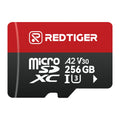
Capacity depends on your use. You might choose a 64GB or 128GB card for a little driving. If you drive a lot or want to use parking mode more, you can use a 256GB card for more video time.
